Lost… and found. How a bowl of Aloo Saag Dosa changed my world

img042

I started a new job this month: I’ve met some very nice people, and it promises to be a fascinating project.

And maybe it’s because the company is a global travel player, but I’ve never worked with such a nomadic group of colleagues. Every time I phone anyone, they’re somewhere new. And in 25 days in the role, I’ve only worked two consecutive days in one place.

As a result, I’ve spent many early mornings and late evenings grappling with brand new commutes – and feeling blissfully, totally lost. In four weeks, I’ve been in more ‘wrong half of split train’, ‘train going fast through next stop’, ‘no train for 50 minutes’, ‘train just left from a different platform’ scenarios than in the previous decade put together.

In the context of a #curryblog, I mention this period of ‘lostness’ because it feels weirdly like a period when I tried to shapeshift from ‘curry consumer’ to ‘curry cook’.

I can time that transition pretty much to the day.

The year was 2008, the month was December, and on the last Wednesday of the month I was eating in Glasgow’s legendary Mother India. For two years, I’d commuted weekly from London to Scotland, and filled one evening away from home in the delicious company of this local hero.

In some restaurants, you don’t get to know the team as friends, no matter how often you go there. But in Glasgow, and particularly in Mother India, you do. So it was a bit emotional when I settled up after the last of literally a hundred or so meals with them – and told the team I wouldn’t be back for some time.

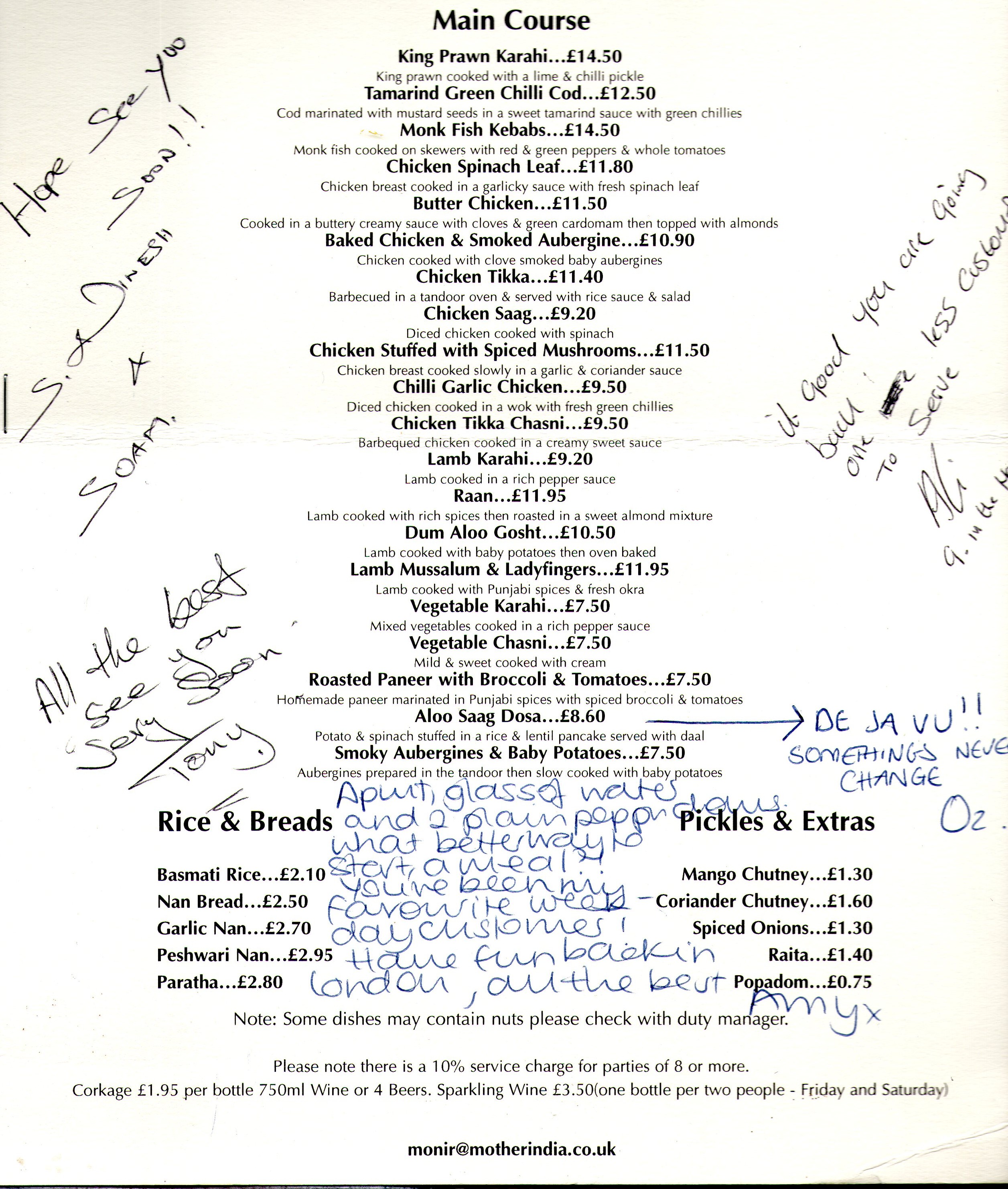
They gave a me a pint of Kingfisher, and just before I left they gave me a copy of the day’s menu, signed by Ali, Amy, Dinesh, Oz, Soam and Tony – with all the messages you can read above.

Four years on, I still miss the team, and I miss Mother India.

Back in London, January 2010, I had the very pressing need to find the food that Mother India had been cooking me. If I’d known more about Indian food, I’d have known to look for great Aloo Saag Dosa with Sambhar in a South Indian restaurant. Or I’d have known to hunt for Mother India’s sensational steamed fish with mustard cooked by a Punjabi chef.

But I didn’t know a thing. I didn’t even know that Mother India is the name of arguably the greatest Bollywood classic ever made. All I had was the name of the destination – all the dishes that had blown me away in Mother India – but no map to get me back there.

I did what we all do. I bought books, I hunted online, I talked to friends and colleagues. The dish that haunted me was Mother India’s Aloo Saag Dosa – and particularly the intense, smokey Sambhar they served it with.

Little by little, I started to get there. I swapped bottled tamarind for the plummy, home-made original – steeped over four hours in fresh tamarind pods and beans. I hunted down the exotic ‘drumstick’ vegetable that lit up my meal in Glasgow. I stopped buying ready-made powder and ground the dozen-plus Sambhar spices I found in different recipes. Once, I even sat down for a Sambhar masterclass with Vineet Bhatia in his Rasoi restaurant. (Thank you, Vineet, for finding time to talk to a curry-obsessed customer at close to midnight!)

I’m getting there. But have I arrived? Can I recreate the giddy Aloo Saag Dosa masterpiece that I ate in Mother India?

I’m not even close.

Can I cook a Sambhar that’s so good you have to put your cutlery down, and just ponder the moment as the spices play games with your head – like the yellows in Van Gogh’s Sunflowers?

Not yet. Maybe never.

But I am on my #curryjourney, and loving every second of it. Loving the new flavours, the new ingredients, the new cook books, the new cooking gear, the new shops, the new friends and ideas from Twitter. Loving the whole nine yards.

And if you’re reading this in Glasgow – and in Mother India – PLEASE share your Sambhar recipe with me. I’ll fly up, go anywhere, do anything.

Until then… a big thank you to Ali, Amy, Dinesh, Oz, Soam and Tony at my favourite Scottish restaurant. And a special thank you to the Head Chef (who’s signature starts with an ‘M’ and ends with an ‘n’ – and loops in between). Your note on my menu cum leaving-card reads:

‘Hope you enjoyed my cooking’.

I did.

I truly did.

Thank you for launching me on the journey of a lifetime.

Good Korma.

Posted in Curry journey | Leave a comment

Beyond beyond: @biryaniquest reports live on a search for the Holy Grail

chicken biryani cc

As an archaeologist I would be tempted to say that the reason I am so obsessed with biryanis is because I am fascinated by the history, opulence, art and culture of the Islamic period they were invented in.

Or as a staunch disciple of the great cultural anthropologist Marvin Harris, I could justify my mania for this extremely delicious dish by pointing to my Brahmanic genes  – my strictly vegetarian Brahmin ancestors were denied meat, onions and garlic so I am making up for generations of deprivation by focusing on a dish that has all the aforementioned in plenty.

Yes?

No!

The truth is I have no idea why I love biryanis so much – I always have and always will. Bas – as we say in Hindi to emphasize a point that does not need explaining.

To the uninitiated, a “biryani” is a dish of fragrant rice flavoured with spices atop a mound of cooked meat, fish or vegetables. It is normally accompanied by a yogurt raita (salad) or with a meat or vegetable gravy. The latter in my opinion is only served in very discerning eateries that offer top quality biryanis.

I had my first proper chicken biryani (yes, with the accompanying gravy) aged 8 ½ in a rundown restaurant called Olympus in the Indian city of Bangalore. To the shock of my Mum and my sisters I polished off an adult portion and had to be wheeled out of the place.

Back home in our little town in India, my mum sent our maid off to a family friend’s kitchen to master the art of making genuine biryanis from the Indian city of Hyderabad. The maid sniffed at their ‘dirty’ kitchen, cleaned it first and came back with expert knowledge. Thereafter my mother made biryanis for us every other Sunday.

In adulthood having moved to Bombay, the obsession continued and a completely inebriated me encountered Café Noorani in Haji Ali at 3am – this being the only self respecting restaurant open at that ungodly hour. I had a chicken tikka biryani and was hooked for life. I had it once again in the sober, harsh glare of daylight just to be sure and I still remained hooked. Thereafter for a decade I looked no further than Noorani for sustenance.

I live in London now and along with the usual homesickness for family, friends, and Indian clothes came the overpowering craving for Indian food – biryanis in particular. And hence began the quest with the realization that I would have to kiss a lot of frogs before I find my prince; smell a lot of flowers before I find the perfect rose; encounter tons of hyacinths before I find the beautiful lotus – I think you get my drift.

How will I know when I find the perfect biryani? What happens when you find your soulmate? You just know, right?

Join my quest at http://www.kundaskitchen.co.uk/biryaniquest

If you’ve had a great biryani recently I would love to hear from you!


Posted in Guest posts | Leave a comment

If you want to taste ’70s Britain – eat Heinz Beanz Curry

049

I like Heinz. On more occasions than I care to remember, I’ve turned to Heinz beans, Heinz tomato sauce and even Heinz tinned soups when the cupboard was bare (literally and metaphorically). Heinz has always been there for me.

So, imagine my excitement when I saw ‘Heinz Beanz Curry’ on the shelves of my local supermarket. This was going to be good.

In one can, I had the two book-ends of my culinary life: the ’70s me’ who survived on beans, and the ‘2013 me’ who lives for curry. I could hardly wait to get the curried Beanz home.

‘Heinz Beanz Curry’ also intrigues me because one of my lunchtime staples is my own, no-nonsense, homemade ‘Curried Beanz’. I pan-fry an onion and two fresh green birdseye chillies in ghee, pour over the Heinz Beanz (Original flavour!) – simmer – and serve with warm bread. It’s delicious. (In fact, it’s so good I sometimes wonder if I’ll serve it to friends as a starter. If someone can tell me the Hindi translation, I will.)

Back to my new discovery: I start to simmer the ‘Heinz Beanz Curry’, and somehow the sight of a saucepan full of bubbling haricots in red sauce brings the 70s hurtling back towards me.

From the comfort of digital, cosmopolitan, multicultural 21st-century Britain, it’s hard to remember just what a desert the 70s were in this country.

Wherever you looked, 70s Britain was a war zone. Somehow, in just a few years, we’d extinguished the beacon of 60s futuristic fashion, music and relationships for… the ‘flick parting’…. the medallion!

In years to come, I predict that open-mouthed social historians will find it beyond belief that women in the 70s of marriageable age chose to plaster their hair to the side of their head with lacquer in a ‘flick’ – like a dessicated bird’s wing stuck to a wall. Young men looking for mates, meanwhile, undid their shirts to the navel – and hung lumps of unprecious metal on their chest.

It’s a miracle that the species reproduced.

I could go on… the thuggish 70s politics, the lumpen football, the popular-music scene where The Muppets outsold career musicians. And that’s before we even glance at the tragedy that was British food in the 70s: groups of drunken British males shouting at waiters in Indian restaurants to cook them a curry with so much cayenne it would almost hospitalise them.

For those considering sawing their own heads off in the 70s, it was probably only the healing influence of David Bowie, Marc Bolan and John Cleese that kept you from the edge.

My ‘Heinz Beanz Curry’ has warmed. I try a spoonful.

BLEURGH!!

Out of sheer forensic curiosity, I go back in. It’s baffling… the taste seems both over-sweet and heavy with spice at the same time. It’s like a tango where the partners are trying trip each other up, as they trade murderous glances.

As I said, I like Heinz. I’m sure they’ve spent thousands or tens of thousands of pounds researching, refining and perfecting ‘Heinz Beanz Curry’. I’m sure that hundreds of Brit’s in focus groups have told them it’s delicious. I’m sure they’re all right, and that I’m wrong. I’m sure it’s lovely.

But for me, ‘Heinz Beanz Curry’ captures the taste of the 70s. If you’re too young to remember (or you were there, and you’ve blotted out the memory) – and if you really want to know what it was like to be in a country that had completely forgotten what taste was all about – try a spoonful.

Posted in Indian kitchen | Leave a comment

Multi-regional cookboks

img039img036img040

The great cookbooks on Indian multi-regional cuisine are, for me, where the curry journey gets serious.

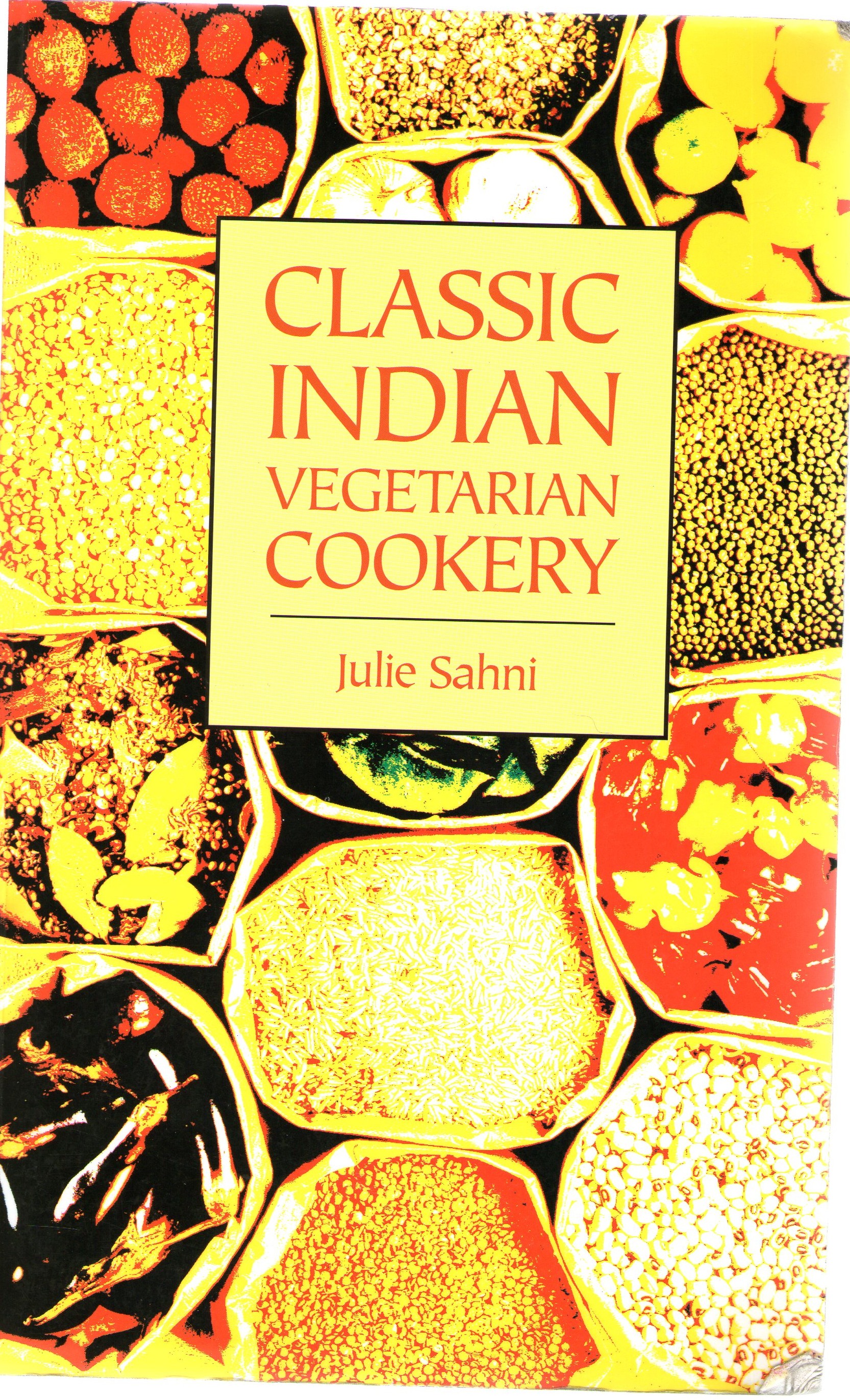
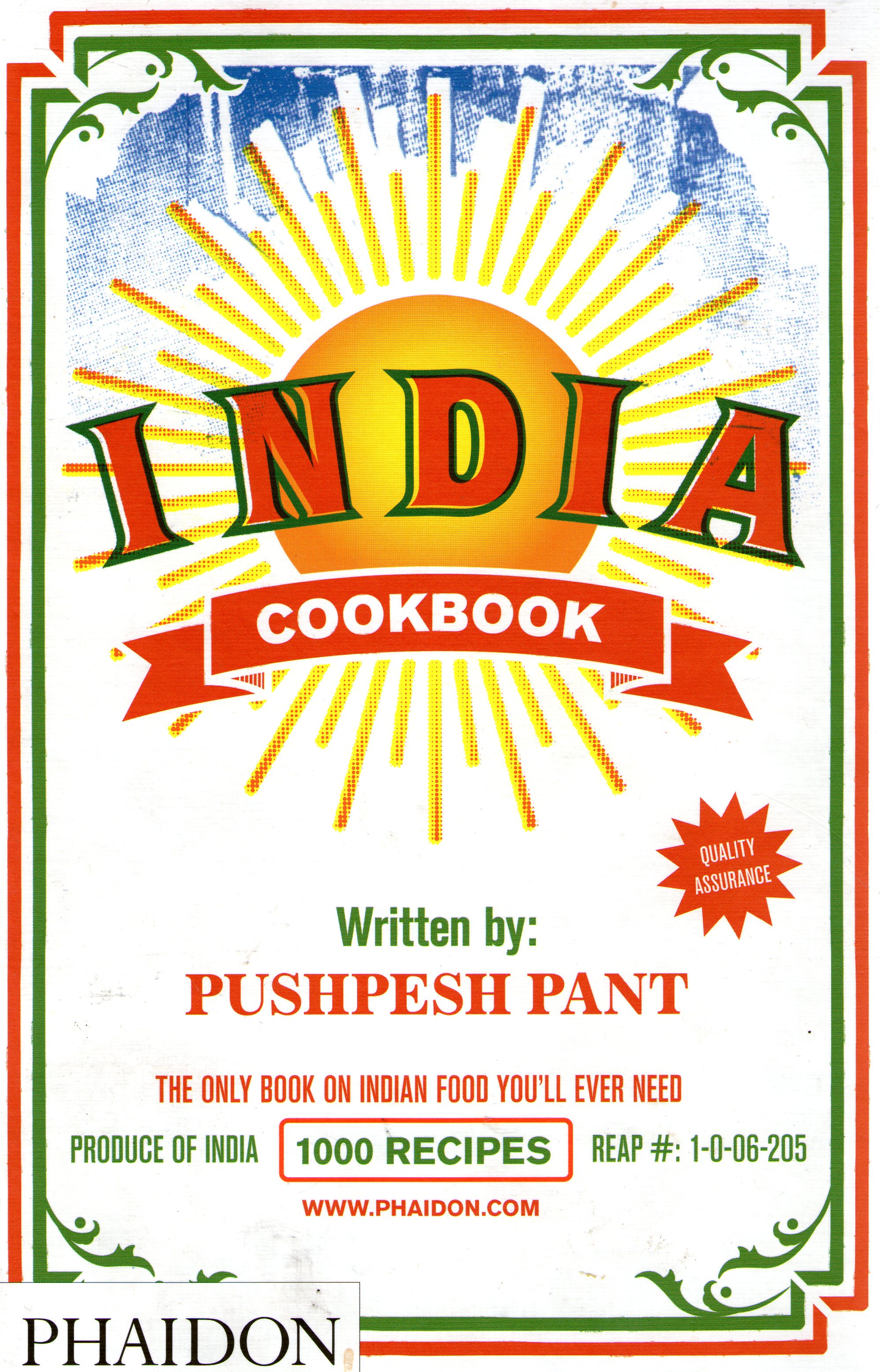
Meera Taneja, Pushpeshpant Pant and Julie Sahni all take a panoramic view of the classic recipes across the country – and each book, in its own way, helps convert you from ‘spice pedestrian’ into ‘spice pilgrim’.

Google ‘best Indian recipe book’ (as I often do… adding ‘gourmet’, ‘authentic’, ‘collectable’, etc to take me to new volumes) and the name Meera Taneja comes up time and gain. Given that Indian Regional Cookery was first published in 1980, it’s a tribute to the author that copies and reviews of the book are to be found all over the web… more than 30 years later. My mint condition, first edition copy reached me a month ago, and Taneja’s ‘Moong beans and coconut’ and ‘Gujurati stuffed aubergines’ were both spectacular. I cannot wait to attempt the ‘Fenugreek leaf fritters’. Indian Regional Cookery is a landmark – written way ahead of its time – and steers you across the regional masterpieces with skill and feeling. (And if the styling of the photos reminds you ever-so-slightly of 80s album covers, then that’s all part of the charm.) The fact it’s published by Mills & Boon also gives you a bodice-ripper on your spice shelf! Seriously good book.

Moving on, we come to the ‘Odyssey’ that is Pushpesh Pant‘s India Cookbook. No other book I know shouts its metric weight from the spine (‘1.5 KG’) and no other cookbook I’ve ever used takes you on a journey through 1,000 recipes. First, though, the list of criticisms. As literally dozens of reviewers point out online (India Cookbook stirs up a lot passion), the book is rich with typo’s, missing ingredients, missing cooking stages and extra ingredients that never get never get factored in (not to mention an entire recipe that’s repeated verbatim on consecutive pages – 318/19, if you’re interested). But, for me, all this carping misses the point (kind of like criticising War & Peace for having too many characters). I love the India Cookbook, and as a family, we’ve cooked over 20 recipes from this meisterwerk. As with every new curry, we write an instant review on the page, and I’ll let the food critics at our table speak for themselves: Broad beans with coriander ‘Yum… never, EVER enjoyed broad beans so much!’; Tadka dal ‘Oh, oh, oh! Heavenly’; Thali Peeth ‘It’s bread, Jim, but not as we know it… massive, earthy flavour’. I could quote more, but you get the point. The recipes in this book take your cooking to a new level – and with 1,000 to choose from, you will never have an ingredient in your home or in your Asian foodstore that you cannot transform into something delicious. The India Cookbook is definitely not for beginners – but if you want a walk on the wild-side with the Tolstoy of India cooking, Pushpesh Pant is your man.

Peek inside the cover of our copy of Classic Indian Vegetarian Cookery, and you’ll find the following words scribbled inside: “April 14. Cowabunga Julie, you is on fire!! Just ate your: braised butternut and jaggery; 5 jewels dahl; saffron mango chutney, Nirvana bread. Incredible.” Not the most balanced piece of prose – but sometimes you have to shout it rather than write it. Classic Indian Vegetarian Cookery succeeds on so many levels that it’s difficult to know what to praise first. The intro’ is simply a master-class in understanding and cooking Indian food. The recipes not only work – but actually redefine your understanding of the words ‘delicious’ and ‘curry’. (If you need convincing, please try Sahni’s ‘Courgette in sweet milk sauce with chilli flakes’.) Time after time, she helps you create perfection on a plate. And if that’s not enough, every recipe starts with a mouth-watering overview that places the dish in time and place – before Sahni seduces you with her pillow talk. Maybe it’s just me, but phrases like: ‘fragrant butter-laced’, ‘silky rice smothered in’ et al make me almost as hungry as the food itself. There may be a more thrilling curry cookbook out there than Classic Indian Vegetarian Cookery – but Littlewoods would need to offer huge odds for me to chance a fiver on it.

Posted in Greatest Indian cookbooks | 4 Comments

Apple 2.0 – taste the next generation chutney

Bramley

Read the blogs and cookbooks of the great Indian wordsmiths, and you often come back to a common theme: how their love of food started in earliest childhood.

Plotting the course of the seasons, these writers evoke how the different ingredients arriving in their house (green mangoes, yellow mangoes, banana flowers, banana fruit) inspired different menus and dishes.

The memories are evoked with feeling, and reconnect you with a child’s fascination for taste and smell. You want to be there, as the kids savour the spicy kernels at the end a green mango curry.

Childhood in Britain in the 60s was a lot less exotic. Trust me… I was there. The seasons sometimes changed, but the food didn’t – an endless assault of over-boiled vegetables and stewed fruit.

So imagine my surprise – when I ask the helpful staff in the Kohinoor Kerala to name the sensational fruit in the chutney I’m eating, and they reply: ‘Bramley’.

BRAMLEY? Really? This is a fruit I remember with real fear from the 60s, an apple that grew in thousands on trees in our garden, and in almost every neighbour’s garden. A fruit that was fed to me for six months of the year in a slow-moving avalanche of pies, crumbles, stews, compotes and jams. I could taste Bramley in my sleep.

And yet here it was – the same fruit – transformed by the chef in Kohinoor Kerala into the tingling centrepiece of a truly sensational achari pickle.

Which just goes to show that we did grow up surrounded by exotic ingredients in Britain – we just needed someone from Kerala to show us.

The chef and team at the Kohinoor Kerala cooked a fantastic meal, and also shared the recipe for Bramley pickle (see top of page). Their advice was to add the cubed Bramley to the pan last of all, and stir fry briefly.

Good Korma.

Welcome back, Bramley.

And forgive us for mistreating you for all those years.

Posted in Curry journey | Tagged | 1 Comment

The Daily Grind: promise me you’ll never, ever use pre-ground spice

DSC_0224

If there is ONE THING that will lift your curry to the next level, it’s this:

GRIND YOUR OWN SPICE!!

I have used capitals, exclamation marks – the whole grammatical nine yards – to shout this truth from the rooftops.

GRIND YOUR OWN SPICE!!

For me, the ritual of grinding fresh spices is where curry starts – literally and metaphorically:

  • first, there’s the happy stock-take – checking off each spice you’ll need from the recipe book, and measuring the precise amount into separate dishes.
  • then there’s the heady moment of warming the seeds. Curry bloggers debate how many seconds you should warm the spice, and over what heat. My personal preference is to put a small, thick bottomed pan over a low flame – until the base is warm to the touch. I then wait a few seconds, and add the spice (strictly one at a time). This is the good bit… within seconds, the seeds release their volatile oils. Every single time I cook, I lean over the pan to inhale the aroma… for cumin seeds, a deep smell of freshly-sawn wood.
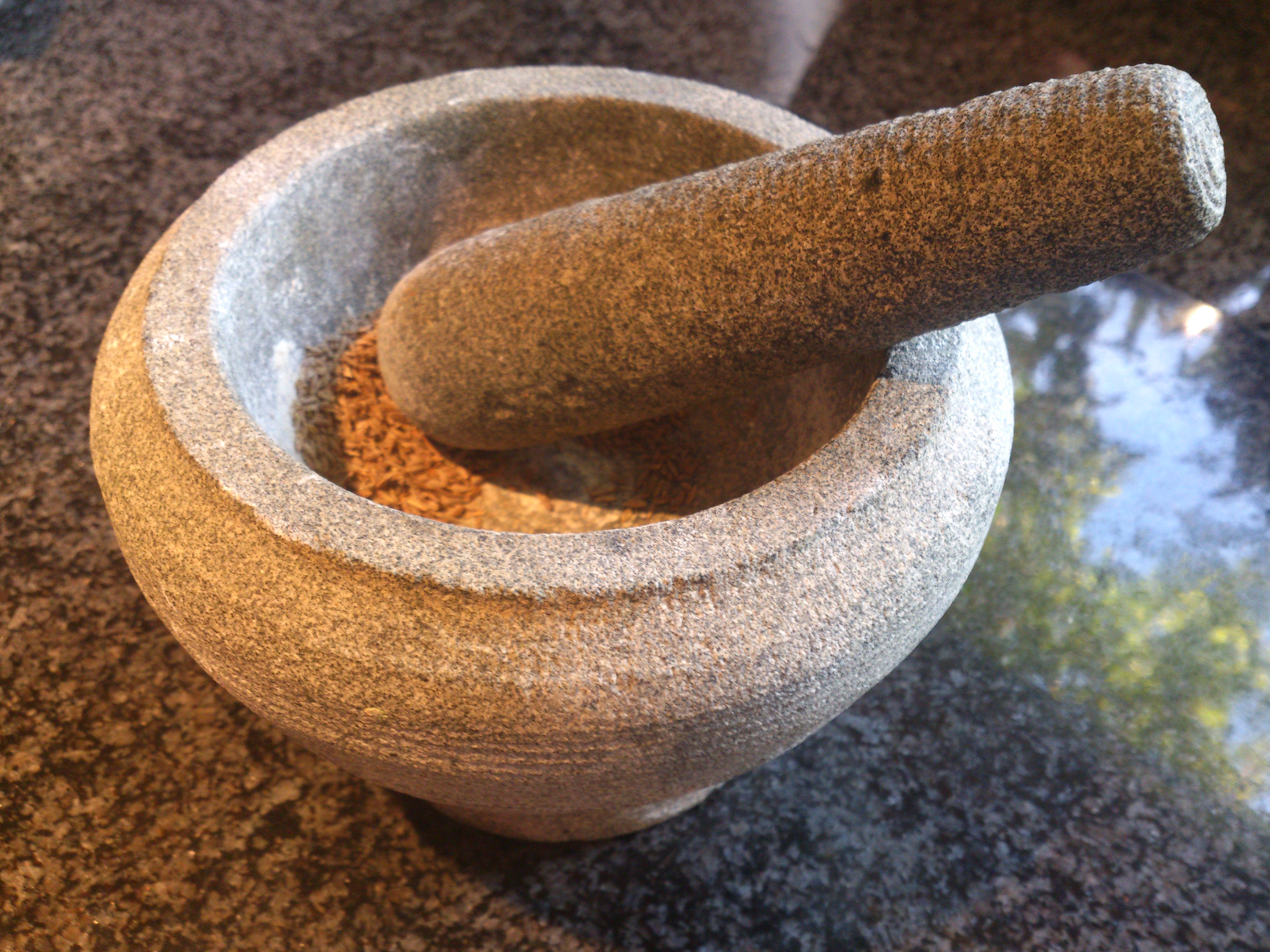
  • finally, a few seconds later… 10 or 12… transfer the warmed spices to your grinder. If you MUST, use an electric or coffee grinder. But why not continue the sensory journey, and grind the spices in a traditional pestle and mortar? For almost all spices (except the tough customers that are fenugreek seeds) the spices crumble under the pestle – releasing a brand new aroma. For cumin, the notes jump an octave  – releasing a sharp, incense-like flavour that will be the backbone of your curry.

With the spices lined up in separate dishes (ground and whole, as needed), you’re now primed to cook like a restaurant pro’.

Of course, as with every golden rule, there are exceptions. I’ve tried working with whole asafoetida (hing) and not only is it tricky to handle but also packs less of a punch than the pre-ground spice. The same is true, for me, of fresh and dried turmeric. And yes, for compound spices, I do use commercial garam masala.

But otherwise, there is no substitute for the daily grind. Even for the big, complex mixes (sambhar) where’re you’re combining seven or eight spices – the only way to get there is to use fresh spice.

Warm and grind your first quantity of cumin seeds, inhale the savour, and discover the key to curry heaven.

If I’m wrong – tweet me.

Posted in Indian kitchen | 2 Comments

Your Asian Retailer: guide, translator and friend rolled into one

063

Alongside the author of your favourite Indian cookbook, the most important person in your curry journey is your local Asian Retailer.

He (or she) is the person who’ll help you understand that Bengal gram, channa dal and kadalai parupu are one and the same thing (in English/ Hindi and Tamil respectively). He or she will tell you when delicious Indian vegetables you’re looking for are in season, and help you to pick between the myriad of chillies (red/ green/ big/ small/ hot/ mild) for tonight’s curry.

Your Asian Retailer is your guide, translator and friend rolled into one – and a team player in every curry you cook.

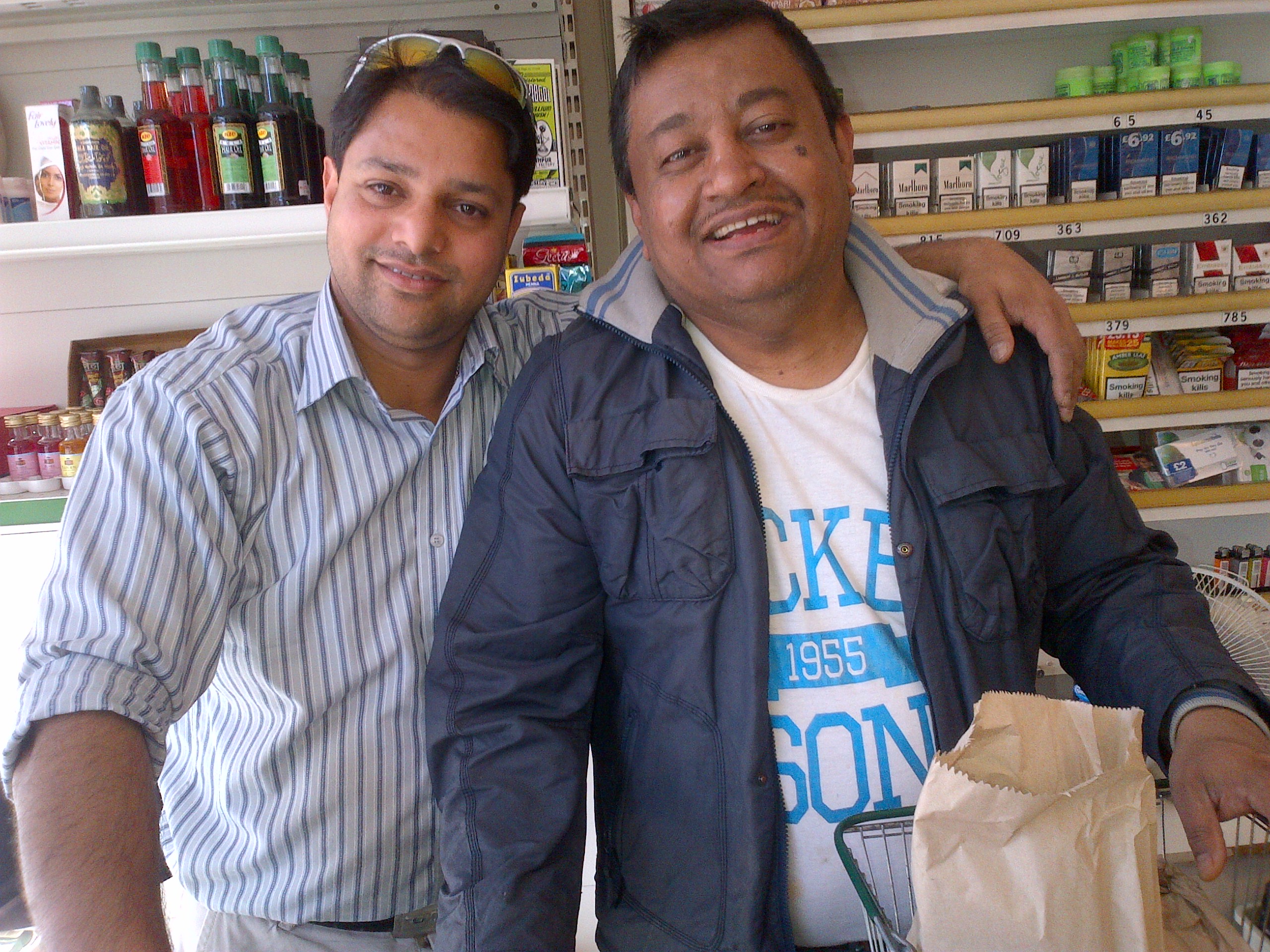
Which is why my weekend doesn’t really start until I say ‘hi’ to the team at The Asian Foodstore, Salisbury. Pictured above are Monir Ullah (left) and Sahab Uddin, chef at the Balti House, Salisbury.

Call me a creature of habit, but at some point every Saturday, I’ll find myself pacing the aisles at the Asian Foodstore – recipe book in hand – as I hunt down ingredients for the weekend. (That’s after we’ve bagged and set aside a dozen of their hot, fresh samosas – before somebody else buys them.)

And talking to Monir and the team, I learn something on every single trip. This week, Monir and Sahab gave me a masterclass in buying coconuts: first, the bit that everyone knows, shaking for water inside the nut and choosing the fruit that sounds most liquid; second, weighing up the sloshiest-sounding nuts in left and right hands – and picking the one that’s heaviest (with flesh full of juice).

I followed their advice. Back home, we broke open the milky-white flesh that gave us the dressing for Julie Sahni’s inspired Sprouted Mung Beans with Coconut (from Classic Indian Vegetarian Cookery). And we couldn’t have got there without the advice and raw materials from Monir and Sahab.

In the next post in Raw Ingredients: The Daily Grind: promise me you’ll never, ever use pre-ground spice

Posted in Indian kitchen | Leave a comment

Getting started

img021img019img022

For almost all of us, Indian cuisine starts with eating someone else’s cooking – and wanting to cook your own. The good news is that there are tried and tested recipe books which will help you do just that. And from the crack of the starting gun, you’ll be cooking some of the most delicious food you’ve ever eaten.

But which book do you choose?

Some books choose you.

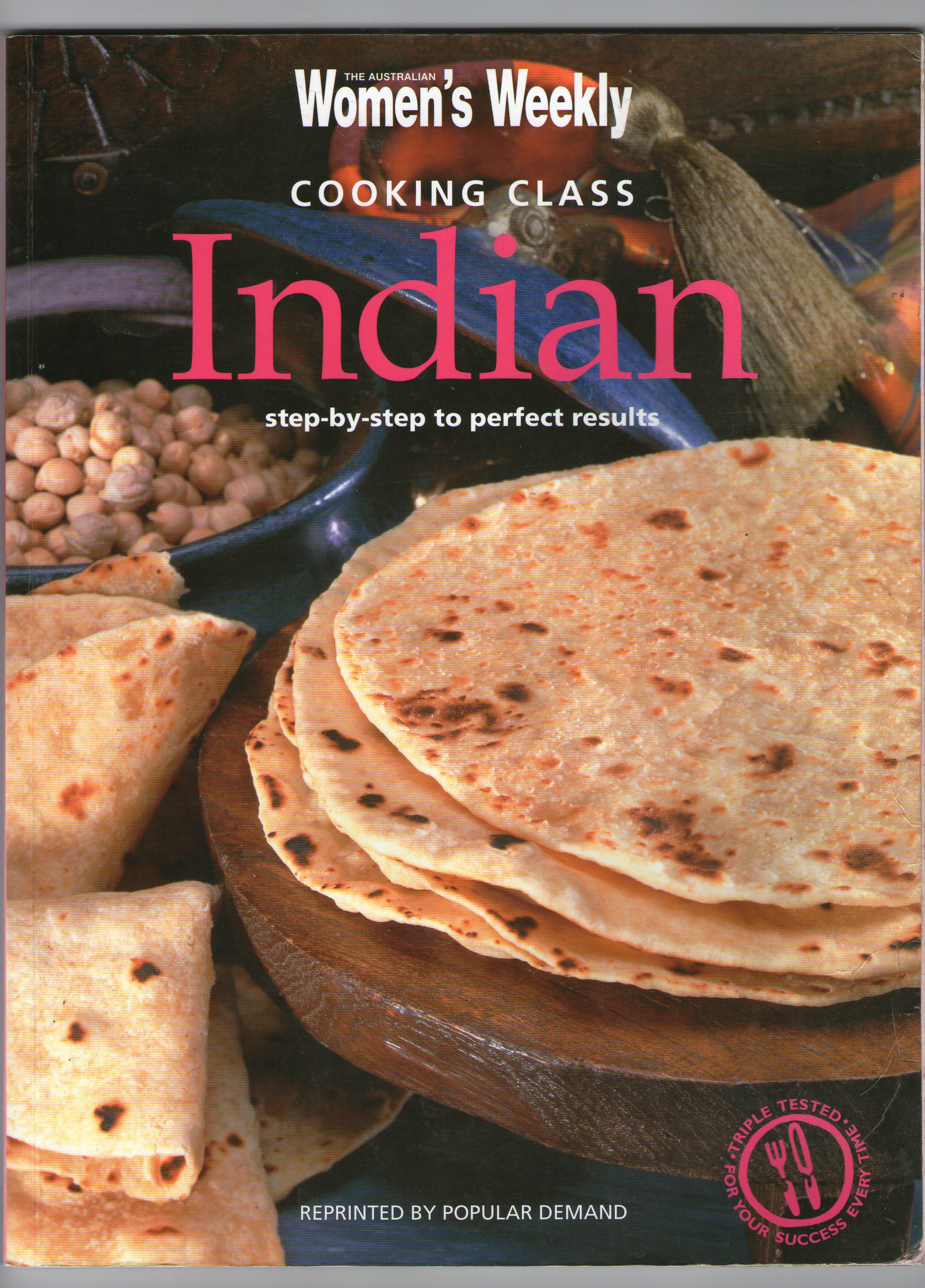
The first Indian recipe book I owned was Cooking Class Indian: step-by-step to perfect results – a birthday present from wife Sue. I’ve cooked from it for four years, and the ghee and turmeric stained pages are proof of its happy times in our kitchen. Even now, I’d rate the recipe for Prawns Dhania Massala as one the most delicious  Indian seafood dishes I’ve eaten (and if you come to our home for a dinner party, you’ll get to know it). The recipes for Aromatic rice, Mixed dal and Mango kulfi are all sure-fire winners. If you’re feeling high-brow, then the numbered, step-by-step recipes and illustrations might feel a bit kindergarten. (And if you’re an alpha male, the Women’s Weekly masthead might be a deal breaker). But for everyone else, Cooking Class Indian is a practical, colourful and delicious first-step on a curry journey. Thank you, Sue.

Camelia Panjabi’s 50 Great Curries of India does what it says on the tin (or on the cover, to be more precise) and steers you through the masterpieces of traditional Indian cooking. The fifty page intro’ is a treasure trove of advice on the philosophy, ingredients and techniques on curry making. Panjabi’s CV as a restaurateur is world-class (Taj Hotels, Bombay Brasserie, Chutney Mary, Veeraswamy, Amaya) and the book oozes love for – and deep knowledge of – Indian food. The recipe for Lamb with plums is a personal all-time favourite. (And I could have cried with gratitude when Panjabi not only told me how to cook the dish – but when I’d seriously overdosed the chilli at a meal for 20 guests – also told me in the intro’ how to dial down the fire in any curry … simply add more of the astringent, in this case… plums). A landmark cookbook.

But we all have to have a favourite starter book, and mine – without question – is The Food of India: a journey for food lovers. Overlooking the fact that the word ‘food’ is repeated twice in the title (and that this wonderful volume comes from the dark star known as Murdoch Books) – The Food of India is a joy to own and cook with. Illustrated with mouth-watering images of street-food from end to end of India, the book steers you effortlessly from simple but delicious classics (Chilli Lamb Cutlets, Chuchumber, Methi Aloo) to high-end delights you struggle to find in gourmet cookbooks (Spiced Banana Flower, Chilli Crab). Every single recipe works with spectacular results, and if you cook your way from cover to cover you will be tempted to think you’re a Domestic Goddess (or God) of Indian cuisine.

In fact, you’ve dipped your little toe in the shallow end of the curryverse.

And you’re starting the culinary adventure of a lifetime.

Posted in Greatest Indian cookbooks | Leave a comment

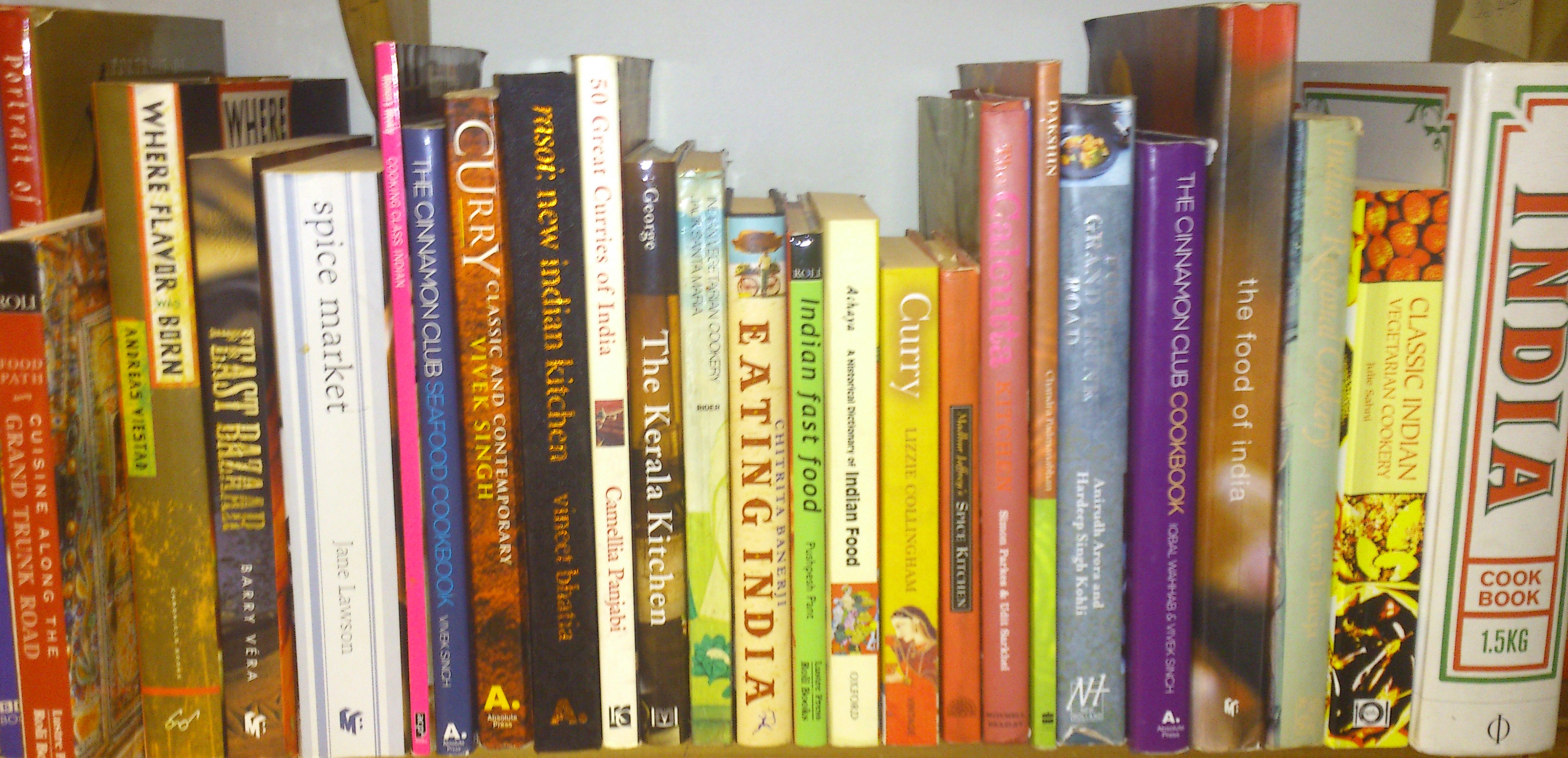
The recipe for recipe books

shelf

If you’re reading this as a member of a foodie Asian family, then this post probably won’t make much sense. You KNOW how to make a great curry, and the recipes are in your DNA. You know your achar from your elaichi. Curry genius is all second nature.

For the rest of us… there are recipe books.

If there’s one national cuisine that you truly can’t bluff you way through, it’s Indian. The sheer number of spices, herbs, seeds, grains and legumes you’ll need (not to mention the thousands of different permutations of grinding, mixing and cooking with them) make the chances of guessing your way to a great curry virtually zero. In fact, take your eyes off a curry recipe for ten minutes – and you’re almost certainly heading off-piste (in a bad way).

Curry recipe books are the Magna Carta of successful Indian cooking.

If you start your search for Indian recipe books in Waterstone’s, it doesn’t look too intimidating. Even the bigger branches stock 15-20 curry cookbooks at any one time – normally a smattering of ‘British Celebrity Chef does Curry’ (Hairy Bikers, Gordon Ramsey… take a bow) plus a selection of books by Indian authors. It all looks pretty manageable.

Then you go online, and experience your culinary Big Bang. Like medieval man swapping a geocentric view of the solar system for a glimpse of Planet Earth as a grain of sand on a beach – you realise the ‘curryverse’ is infinite.

Try it for yourself.

Search for a curry cookbook online, click on ‘people also bought’, click again, again, and again… and you’ll never even glimpse the horizon. Splintering off into sub-sections (vegetarian, regional, religious, seasonal, travelogue, historical, nutritional… and many more) there’s an infinity of Indian recipe books out there.

And you want the best of the best.

You want a cookbook that’s perfect for your stage in your ‘curry journey’. You want a book with soul, a book that will give you the alchemical power to cook the most delicious food that you or your friends have ever eaten.

That’s where my next posts will go.

Over the coming days, I’ll review dozens of curry cookbooks under the following themes:

  • Getting started (great, simple recipes)
  • Multi-country (cuisines of different Asian countries)
  • Multi-regional (cuisines of different Indian states)
  • Regional (cuisines of individual Indian states)
  • Masterclass (gourmet/ restaurant)
  • Beyond beyond (historical/ encyclopaedias)

And somewhere on that journey, I promise to review ‘fennel-scented parathas with sugar’ – a pan-fried bread which we cooked at home this week and re-defines the concept of ‘savoury and sweet’. Indescribably delicious.

Can anyone tell me the Hindi for ‘bon appetit’?

Posted in Greatest Indian cookbooks | Leave a comment

Multi-country cookbooks

img025img026img027

It’s a fact that – as a curry cook – you may want to surf across the cuisines of the Middle East and Asia to find the place where your palate says ‘wow’!

If you do, then are some great cookbooks to keep you company.

Feast Bazaar, Where Flavour was Born, and Spice Market all sit on my shelf at home – and each has helped me along my curry journey.

Where Flavour was Born took me on a spice safari from Zanibar to Malaysia and beyond, persuaded me to wear gloves when chopping fresh chilli (a must), and painted an unforgettable picture of the author foraging for fresh tamarind pods among a herd of wild elephants. Feast Bazaar toured me happily through the great dishes of Morocco, Syria and India. Spice Market planned the food journey a different way – with chapters on every seed/ berry/ root and spice known to man – all linked back to great recipes defined by that ingredient.

Each of these books is beautifully illustrated, and packed both with great recipes and insightful curry knowledge. The authors know their curry onions. If you’re hovering between the spicy delights of a Berber tagine, Balinese suckling pig and Cape Malay curry – then you are in perfect company.

But… but… if you’re a ‘masalaholic’ – and your curry journey is all about India – I don’t think these are the books to inspire you.

As a ‘masalaholic’, you want a cookbook that you find yourself devouring cover-to-cover like a novel… an author you want to invite to dinner… and recipes so delicious you want to tattoo them on your chest.

Feast Bazaar, Where Flavour was Born, and Spice Market might inspire you to do one or two of the above.

I guarantee that future cookbooks in Good Korma will inspire you to do all three.

Posted in Greatest Indian cookbooks | Leave a comment