

You’re offered a drink in India… which is the living embodiment of a God.
What do you do?
Can a dozen words change the way you see a culture? A country?
These did.
I’m standing on the terrace of a hotel in Varanasi, overlooking the Ganges. Dawn is warming the weathered stones of the ghats, and people are bathing at the edge of the river. Listening to the comforting clatter of tables being set for breakfast, the hotel manager and I watch the scene below.
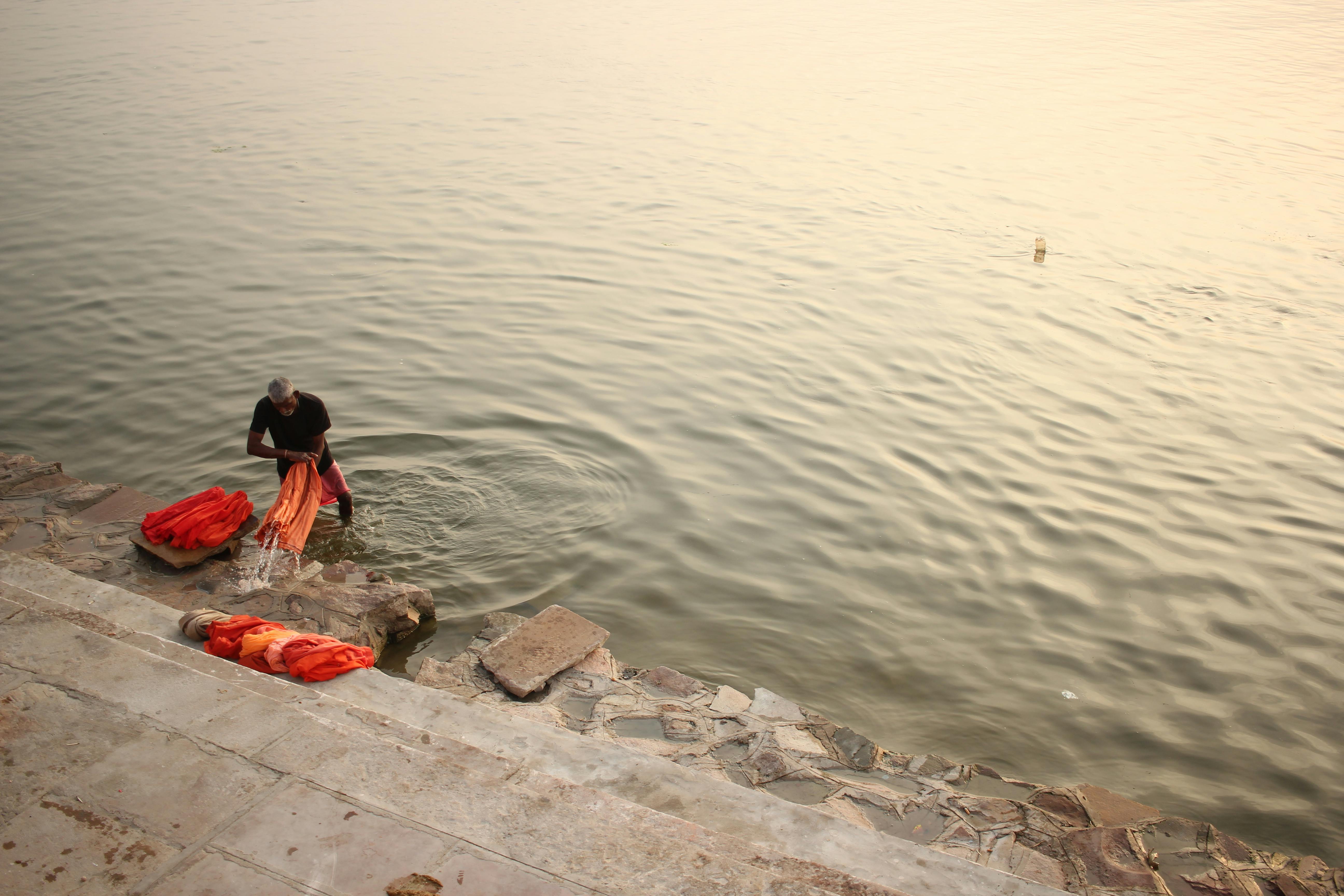
100 yards away, down a flight of steps, an older man stands by himself near the riverbank. His calves are hidden in the water. He leans forward to cup water from the Ganges and pours it slowly over his head.
“What do you see?” asks the hotelier, looking towards the man.
Since checking me in a few days earlier, the manager has kindly been answering my questions on Hindu belief and food.
His next few words will rewire the way I see this man, the river… and India.
From lost hours spent in university libraries, I know that a single sentence has scrambled much, much bigger brains than mine.
One day in the 1920s, the blood literally drained from the face of French philosopher Jean-Paul Sartre as a friend explained the essence of existentialism to him, in a handful of words: that there’s no God, no universal values, no nothing – just the human freedom to fill this void with your own reality.
Right now, standing in the Varanasi dawn, I’m about to have my own mini-JPS moment. And I haven’t even sipped my breakfast chai yet.
“What do you see?” asks the hotelier
Varanasi is supposedly the oldest continually-inhabited space in India: Buddha taught here in 520 BC. I’ve come to the city because Vivek Singh sent me here. Chatting in the Cinamon Club before my trip, the celebrity chef asked me what I was looking for in India.
“Intensity,” I said.
“Go to Varanasi.”
He was right. Even in a country which tourists routinely describe as ‘an assault on the senses’, Varanasi turns every dial up to 11. Within minutes of arriving, I found myself being led to the ghats – and plonked on a stone seat on the banks of the Ganges to watch a human cremation… less than ten feet away. As we watched the ceremony, ashes and bones from previous cremations were scattered in the river.
In terms of Hindu legend, Varanasi’s physical location in the cosmos is on the spike of Lord Shiva’s trident. As eternal home to Lord Shiva the Destroyer, the city is one of the most sacred spaces in India – and Hindus believe that dying here leads to immediate liberation from the cycle of birth and death. The energy is tangible in everything you experience in the city.
So… the hotel manager’s question hangs in the air: WHAT DO I SEE?
To be honest, I see a very polluted river. I see someone risking their health by washing in it. I don’t feel confident to answer his question.
“That man,” continues the hotel manager, “isn’t bathing…
In the pause, all noise around us seems to still.
“He’s communing with a living Goddess.”
I look again at the man in the water. In my head, it’s as if a film that was playing on small-screen black and white has flipped to IMAX.
I’m no longer looking at a river. I’m suddenly face-to-face with at the Ganga: living Goddess of purification, mother of humanity. I’m watching a human being immerse themself in a divinity.
“That man isn’t bathing… he’s communing with a living Goddess.”
For the residents of Varanasi, and for the millions of pilgrims who visit, these truths are axiomatic.
I’ve been shown a door to a different world.
Fast-forward a decade, and I’m in a hotel in South India. We’ve chosen to stay in Areca County in Honnavar, Karnataka, because it specialises in local-sourced, home-cooked vegetarian food. The online blurb promises the Areca County will be: ‘a treat for both the palate and the soul’.
We have no idea how true to their promise they will be.
With a group of cottages scattered around a traditional wooden home – nestled in a private plantation – the hotel is one of the most charming places I’ve stayed in in India. The cottages have immense ceilings (four to five metres high?) with walls carved from slabs of red, local stone. In the main building, you eat under century-old timbers. It’s an intensely soulful place.
The cottages have immense ceilings, with walls carved from slabs of red, local stone. In the main building, you eat under century-old timbers. It’s an intensely soulful place.
The ‘palate and soul’ adventure starts as soon as I meet the chef, Neelakanta. I sense there’s a story to his name.
He explains that ‘neela’ and ‘kanta’ are Tamil for ‘blue’ and ‘throat’… that Lord Shiva drank a poison to protect the universe from its own destructive power – and stored the poison in his throat.
So, Neelakanta’s name evokes the body of Lord Shiva.
Have I ever had a ‘welcome chat’ as deep as this with any other chef, in any other country? I have not.
It feels as if as if the book I opened a decade ago in Varanasi is starting a new chapter.
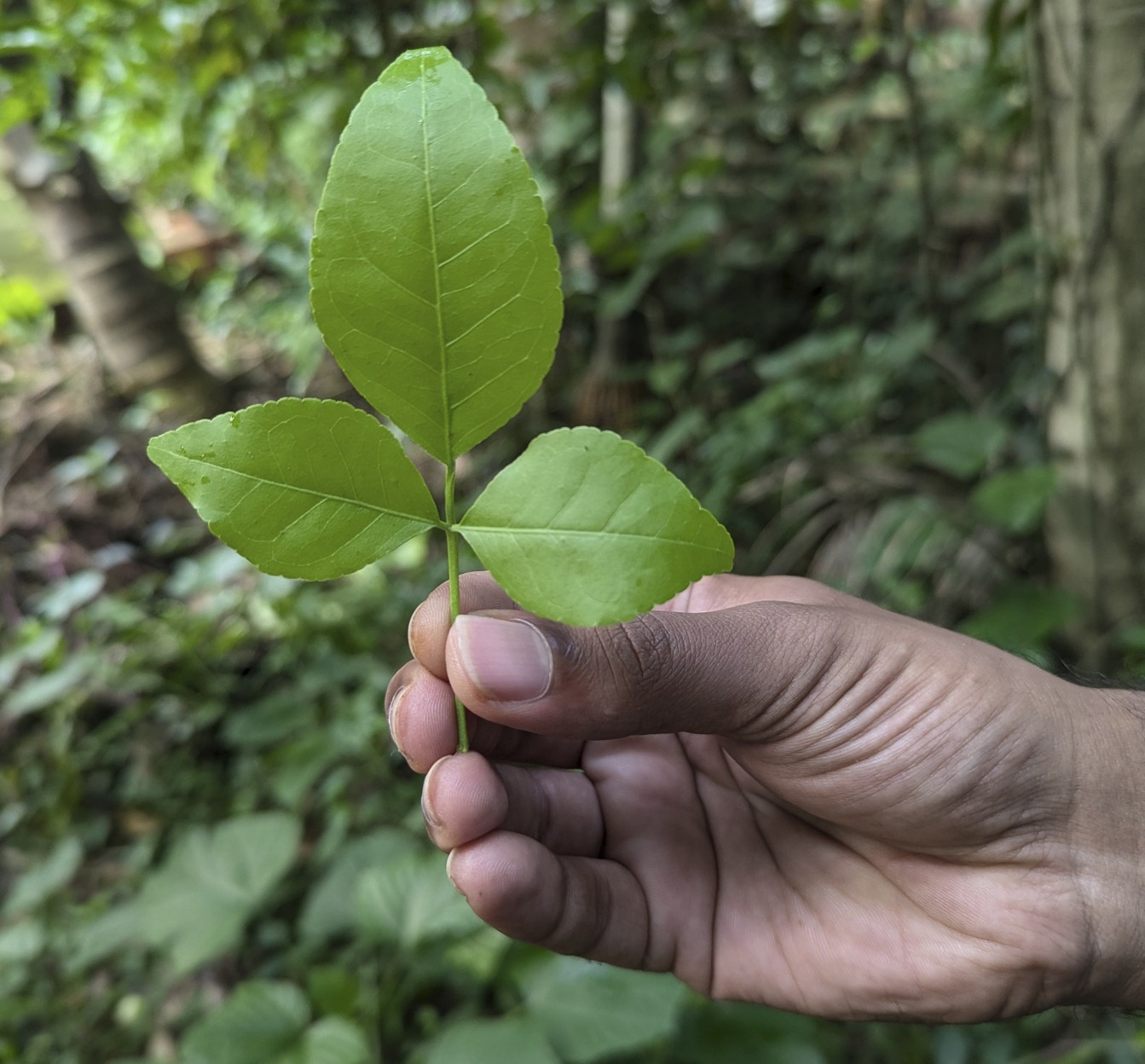
The villa grounds are home to all kinds of ayurvedic plants. Neelakanta takes me for a tour, and we stop in front of a tree – about four metres tall, with a slender trunk, the width of a rugby post.
This is a Bel Patra (or Wood Apple… named after the baseball-sized fruit that’s clad in a rigid, wooden shell). From the bark to the roots, says Neelakanta, every part of the tree has a different healing property. The fruit aids digestion, the juice cools the body in summer.
But right now, it’s the leaves we’re interested in. With their distinctive ‘trifoliate’ shape, the leaves are said to represent the three eyes of Lord Shiva.
Neelakanta picks a leaf and gives it to me. It has an intense smell of camphor. He explains the leaves are used as a temple offering to Lord Shiva.
And because Jeff Bezos has thought of everything, you can buy packs of fresh Bel Patra leaves in the UK on Amazon.
But things are going to get much, much deeper.
Neelakanta explains that the tree is not just sacred to Lord Shiva – the tree is Lord Shiva.
As the Ganga is a living Goddess, so the Bel Patra is a living personification of Lord Shiva.
The drama is intense. A man named after Shiva’s body… is telling me the leaf I’m holding is Lord Shiva himself.
Neelakanta explains the tree is not just sacred to Lord Shiva… the tree is Lord Shiva.
It takes a bit of processing. We go back to the main building for dinner.
At the next table, Vijeta and other guests are celebrating a birthday. After the meal, she and her husband invite me to share cake with them around a campfire.
As he leaves the villa, Neelakanta offers to bring me a drink of Bel Patra the next day.
As the drink appears in the dining room at breakfast, it causes a stir.
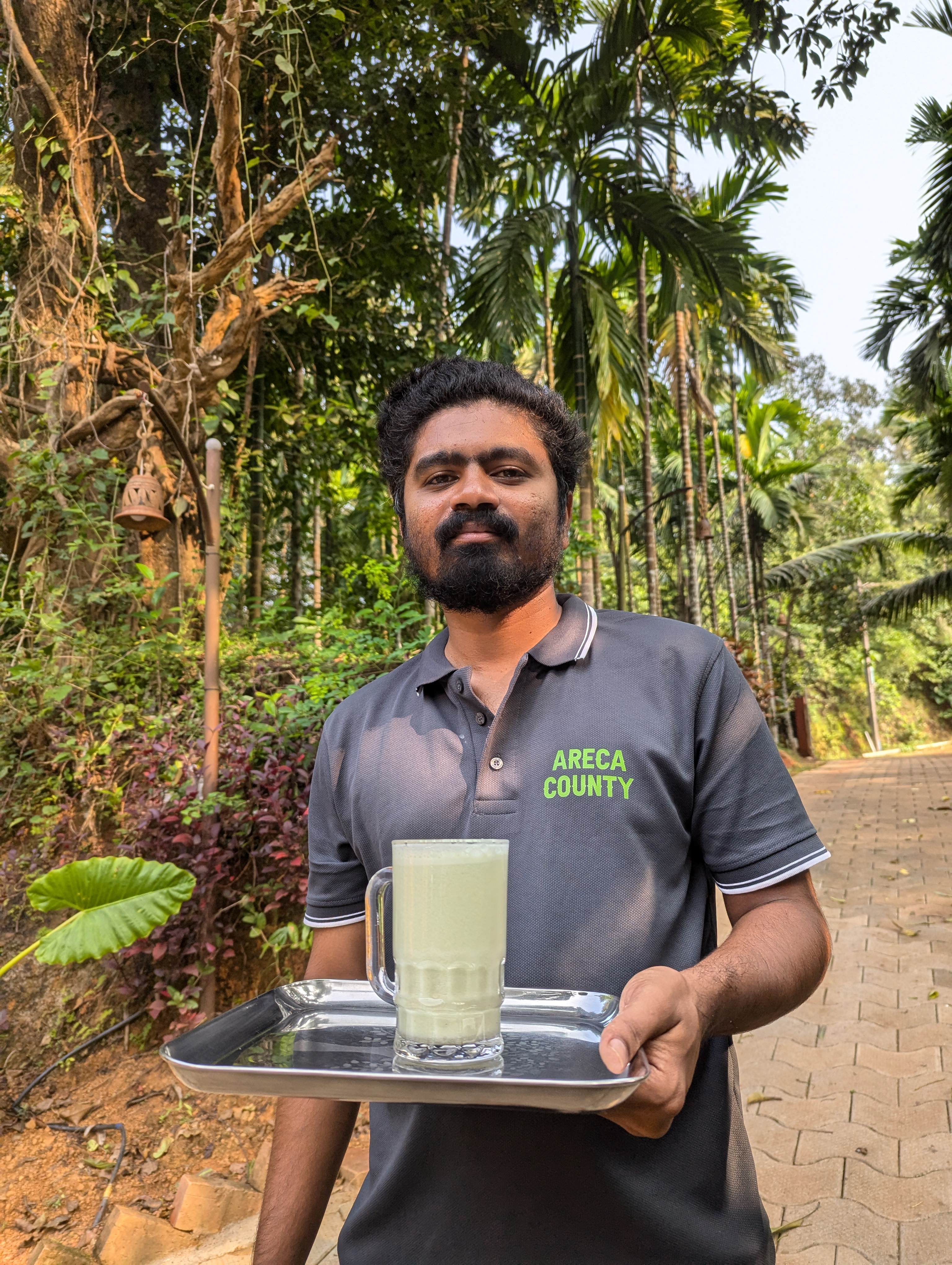
Served in a tall glass, it’s a shade of the Day-Glo colouring of the raw Bel Patra leaves. The drink is made from coconut water, buttermilk and Bel Patra leaves – but the intense smell of camphor grabs you even while the glass is still on the tray.
It is ‘a moment’.
“I’m Indian,” says Vijeta, “and I’ve never seen Bel Patra served as a drink.”
So, we’re in special territory. And, as so often in India, there’s a sense of multiple truths.
For some people, the liquid in front of us is the embodiment of a God; for others, it’s an ayurvedic medicine; for others still, it’s a drink.
The Indian genius, I think, is to respect each truth.
The drink sits on the tray. Do I sit on the bank, or immerse myself? Several of us take a sip.
No one speaks.
For the first – and maybe the only time in the history of this blog – I’m not going to try to describe the flavour. So… this is a foodie blog that consciously ignores the be-all and end-all of food writing: taste.
Holding the glass, I sense this moment is about something else. Connection? Meaning?
We each take another sip. What did my experience of Bel Patra give me?
Is there another country that can transform a river, or a leaf… into a God… before your eyes?
Like the rooftop conversation in Varanasi, it instantly opened my eyes to this cuntry’s sheer generosity.. to India’s passion for sharing its religion and culture.
An open invitation… 24/7.
Everywhere I’ve gone in this country – every temple I’ve visited, every festival I’ve been part of, every ritual I’ve joined – India has welcomed me in.
I drink the Bel Patra again.
Is there another country in the world where you can experience millennia of religion, medicine and cuisine… in one sip?
Is there another country that can transform a river, or a leaf… into a God… before your eyes?
That’s a lot to learn from one drink.
THANKS
My sincere thanks to Areca County and Neelakanta – for approving this piece, and for making this blog possible.
Photo credits: Lord Shiva – Reyney Poojary, Pexels; Man in Ganges – Ashish Kumar Pandey, Pexels


 Good Korma
If I was unsure about whether to include Varanasi in our future India odyssey, I am now all in.
Wonderful descriptive prose, the spirit of India is in you and you are in it. Keep it coming, Ad!