
Are you looking for the most exquisite seafood known to man? Join us on a 700km pilgrimage along the Indian coast… by bike… to the heart of Konkani cuisine.

Stretching over 1000km, the Konkan embraces the western coast of India – meandering through three different states. Until you reach Goa, it’s blissfully quiet and unvisited. In two weeks, I didn’t meet another foreign tourist.
Pedalling into the state of Karnataka (kar-NA-ta-ka) the Konkani beach experience becomes even more intense.
Catching an early-morning ferry in the shadow of the hi-tech skyline of Mangaluru, we join the handful of foot passengers and two-wheelers heading for a narrow isthmus of land.
Just hundreds of yards from the landing jetty, the vista opens up into an infinity of beach. For the rest of the day – across 40k – we’ll be cycling in a straight line, with the Arabian Sea ten metres to our left, and paddy fields to our right. The road is billiard-table smooth, and shaded by palms. The only sounds are surf… and the soft calls of fish salesmen, pedalling slowly through the villages.
It’s a tropical paradise.
The prows of Konkani boats are painted with human eyes, so it’s easy to see where they’re looking.
In a day’s cycling, we see more metre-long giant monitor lizards (two) than cars (zero).
And – as always in the Konkan – the gravitational pull of fish is irresistible.
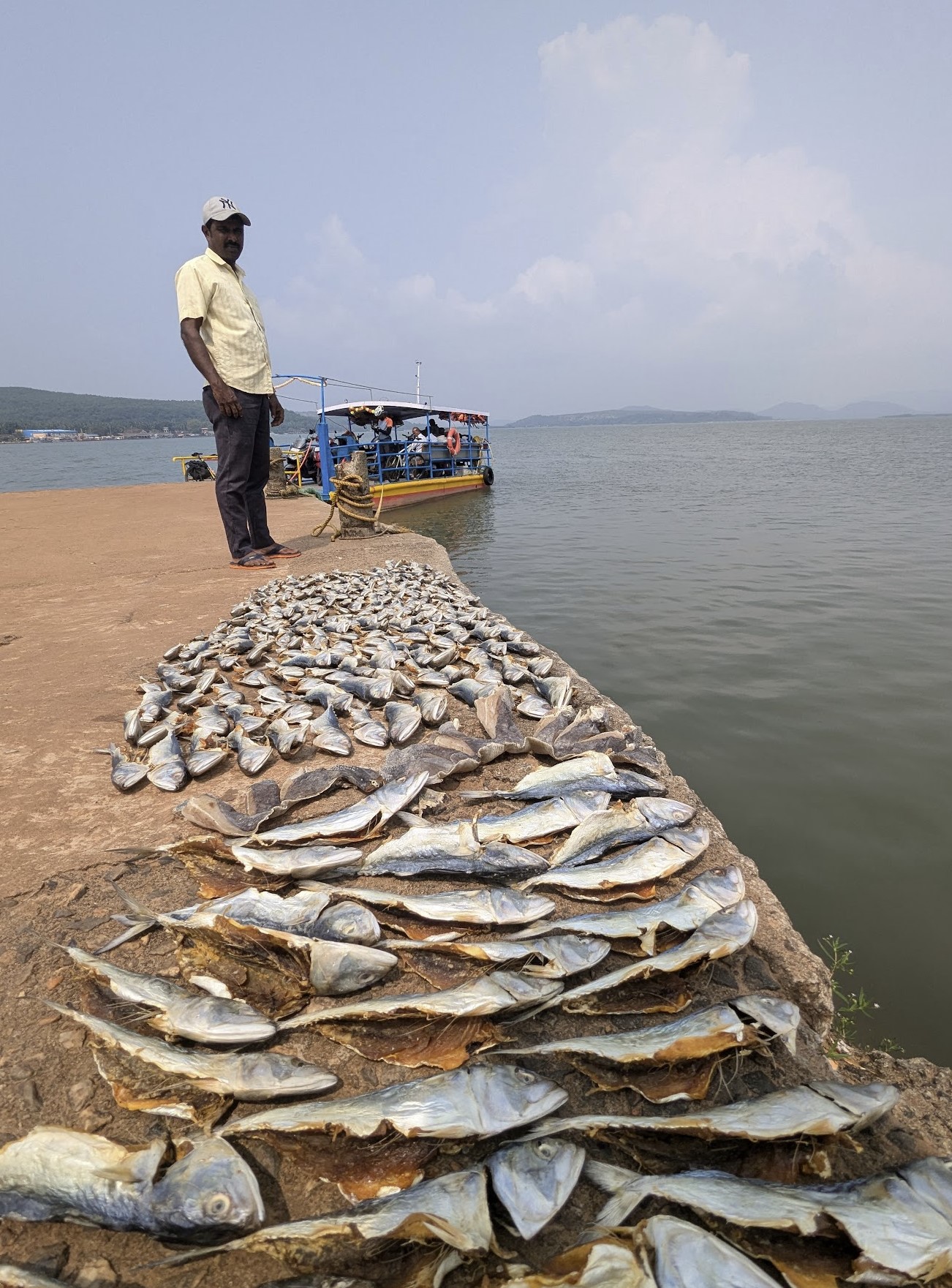
Where there’s a flat surface that isn’t road, someone is drying fish in the sun or selling fish in the shade. Where coconut palms disappear to reveal a bay, wooden fishing boats gaze out to sea. The prows of sea-going Konkani boats are painted with human eyes, so it’s easy to see which way they’re looking. The smaller, one-man boats are basically canoes – so low in the water the fisherman looks as if he’s walking on water.

In a wonderful adventure that brings sea, cyclists and fish together in one seamless experience – we turn a tight corner in a village to see our front wheels suddenly caught in neon fishing nets.
Apologising for being the wrong kind of catch, we unhitch our wheels from the mesh, back up
Local fishermen have transformed the narrow lane between the houses into an open-air workshop, where they’re hanging and repairing their nets. We’re caught up in them. Apologising for being the wrong kind of catch, we unhitch our wheels from the mesh, back up – and push our way round the village on the mud banks of a paddyfield.
In the blood
With every day, the foodie adventures multiply.
In the village of Malpe (mal-pay), we stroll across a beach with sand as fine as talcum powder, and eat whole, fresh tuna at a roadside stall.

In Udupi (oo-doo-pee) we visit the fish market – essentially a foodie museum of everything that swims and crawls in the Arabian ocean. Intriguingly, it’s the only place I’ve seen… anywhere… that’s 100 per cent run by women. We buy glistening king prawns, crabs and clams.
If the Hotel Thimmappa could take away the building itself – and serve pomfret to customers in the sea – they would.
For lunch in Udupi, we order pomfret and ‘disco’ fish at the legendary Hotel Thimmappa. Across South India, every town has its equivalent of the Thimmappa – a bustling restaurant, mostly for working people – that serves super-local food at super-affordable prices. To a visitor, these places – with their ‘all you can eat philosophy’ – feel like a hybrid between catering and social good.
They are always soulful, delicious place to eat – and the Thimmappa is special, because of its focus on seafood. (Including, of course, the intriguing ‘disco fish’ – named by local fishermen because of the light that spins from their eyes at night.)
My pomfret arrives. Looking at the golden, tawa-fried fish – sitting in splendid isolation on its emerald banana leaf – I realise this restaurant has painstakingly removed every possible impediment between the customer and the seafood.
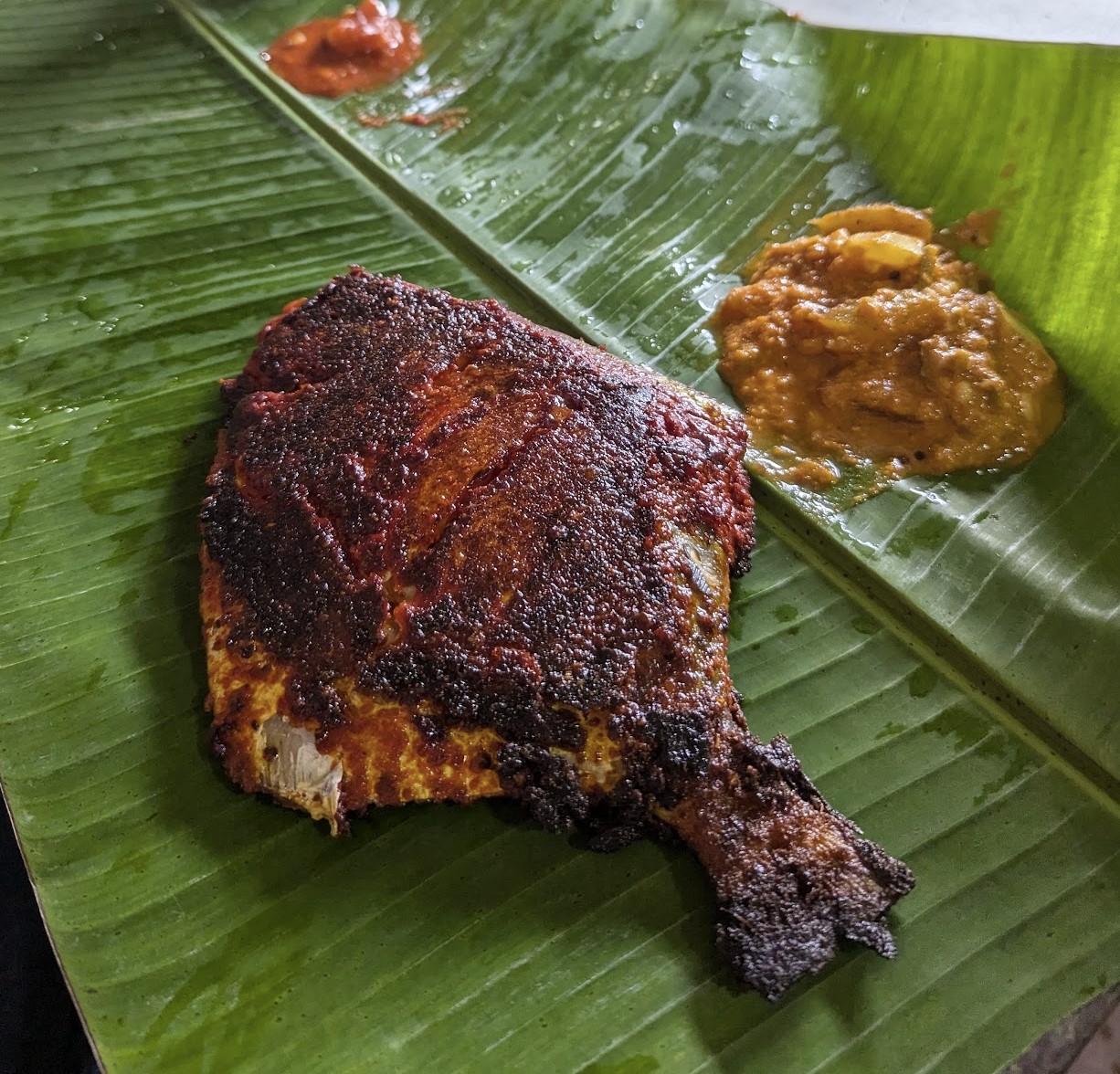
There’s no printed menu, no tablecloth, no crockery… no cutlery.
Just fish.
A mystery-shopper from the Michelin Guide would have a coronary. But I’m in heaven.
I sense that if the Hotel Thimmappa could take away the building itself – and serve the pomfret to customers in the sea – they would.
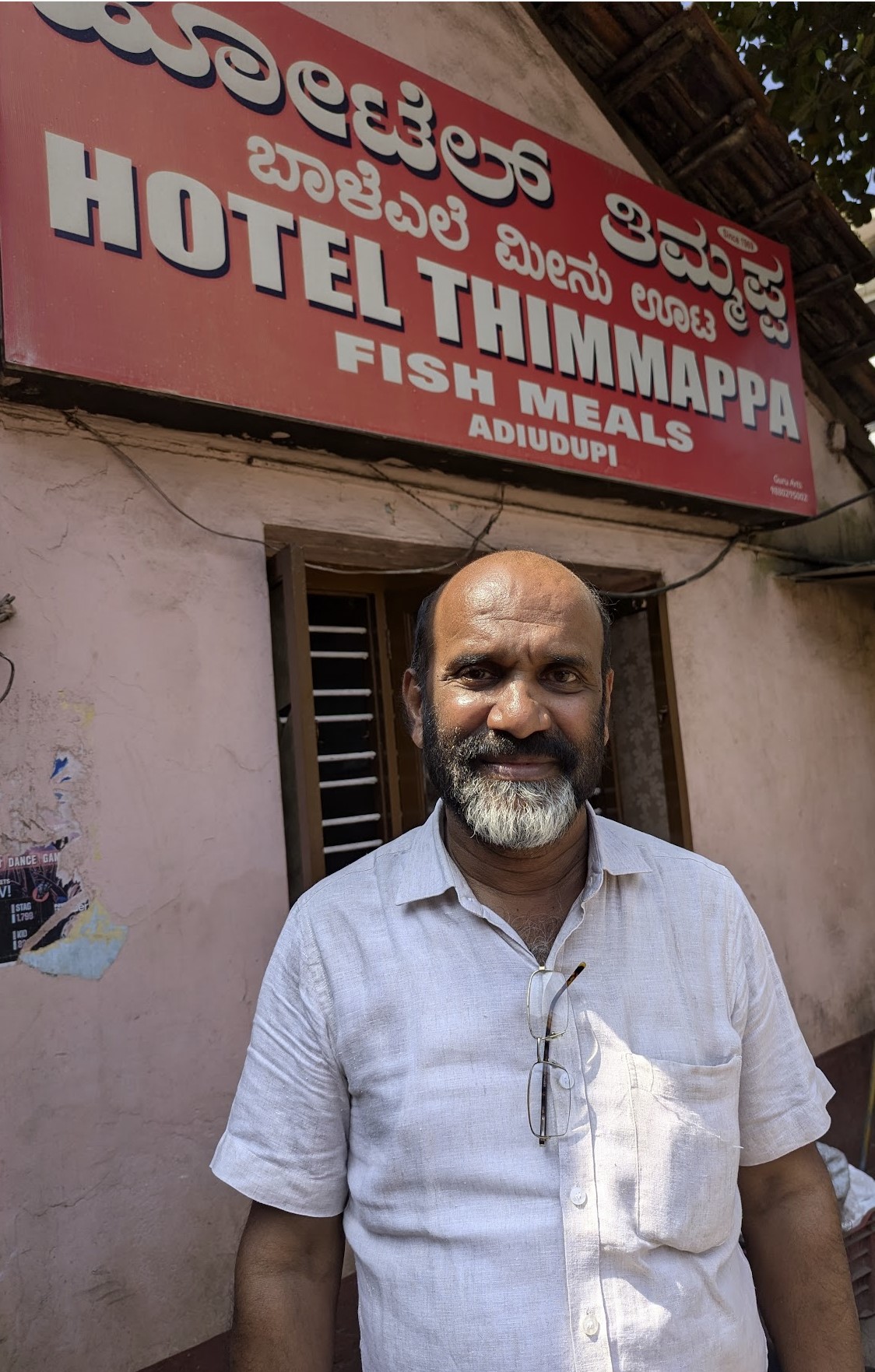
On the side of restaurant, two words sum up their mission: FISH MEALS.
There’s no printed menu, no tablecloth, no crockery… no cutlery. Just fish.
It’s what they do. Fish… from the tawa.
Speaking to the owner, he explains that his father – Mr Thimmappa – ran the restaurant ran for 45 years without a sign. People simply said: ‘Let’s go to Thimmappa’s.’
A decade ago, after his father’s death, they put up the board in his honour. Today, they still use the masala recipe created by his mother – and the owner himself buys every fish served in the restaurant – every day.
And in that instant, I get IT.
It’s like that moment when the optician drops the final plastic lens into the clunky frame – and the tiniest, fuzziest row of letters leap out like a neon headline.
Of course!
Fish and people are the inseparable, intertwining strands of Konkani DNA.
Everything is the Konkan is about fish. Every coastal village, every local market, every beach… they all revolve around fish.
If you see water, someone’s fishing it. If you see an adult, they’re almost certainly in a boat, repairing a net or selling fish by the roadside.
But fishing isn’t just a way-of-life in the Konkan… FISH ARE THE KONKAN!
THE KONKAN IS FISH!
Fish and people are the inseparable, intertwining strands of Konkani DNA.
Cut a Konkani, and he or she bleeds fish.
Pedal with us on the final stop our Konkani pilgrimage.
Scroll down for the next chapter: ‘Coming Home’


 Good Korma