How an Appam – and Azim Premji – taught me about India… and life
OMG!
It is here!
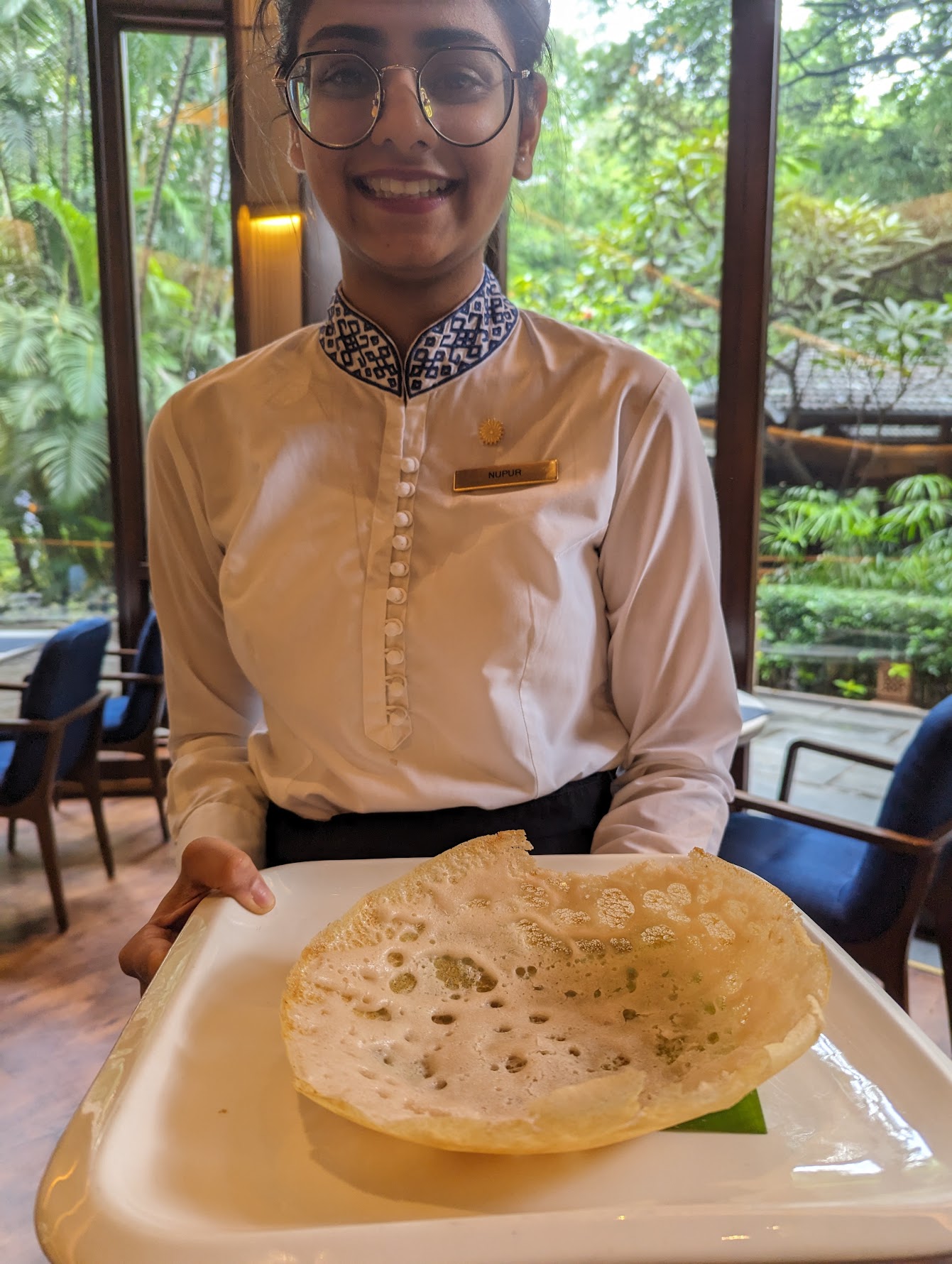
Feather-light, diaphanous… floating like a butterfly between Nupur’s hands… an APPAM!
After a 24-year wait, I’m reunited with a dish that’s probably the most delicious thing I’ve ever eaten.
And, oddly enough, I’m back in the Indian city where I ate my first Appam. The whole thing feels weirdly circular.
For me, the Appam isn’t just the first word in the Dictionary of Deliciousness… it’s also the single dish that’s taught me more than all the rest put together.
Reader… eat an APPAM with me.
Let’s explore India in a single dish.
And… if you’re up for it… let’s taste the human condition.
For me, the Appam isn’t just the first word in the Dictionary of Deliciousness… it’s also the single dish that’s taught me more than all the rest put together.
October 2023.
We’re in Bengaluru, southern India.
They’re serving breakfast at the Oberoi Hotel, and over the course of the week, the staff have clocked me as a foodie. They’ve helped me taste almost everything on their ‘Incredible India’ breakfast menu. It is all, genuinely… incredible.
This morning, Nupur asks me if I’d like to try an Appam.

It’s been almost 25 years since I last ate one.
OF COURSE I WANT AN APPAM!
But we’re in a public space, so I try to hide my excitement.
I just say yes. Inside, I’m screaming “YESSS!!”
But there’s one other, vital question. ‘Appam.. served with stew?’ I ask nervously.
She nods.
O M G!
Appam AND stew!
The next ten minutes are a delicious torment of waiting.
The Oberoi have helped me taste almost everything on their ‘Incredible India’ breakfast menu. It is all, genuinely… incredible.
Rewind two decades.
It’s October 1999, and I’m visiting the same city – Bangalore – to interview Azim Premji, founder of Indian tech giant Wipro.
Mr Premji is not just a tech bro’, he’s also – at the time – India’s richest man.
Arriving at the tenth floor of Wipro’s downtown office, my excitement melts into panic as Premji’s PA tells me he has flu, and will need several days to recover. Speaking faster than I can think, I start gibbering to her about copy deadlines and return flights. The woman looks concerned, and makes a discreet phone call.
One hour later, Premji walks into the room.
I’ve just got the richest man in India out of bed.
Or rather, a very gracious Indian has risen from his sick bed to help a visitor.
Countless times, India has stopped me in my tracks with the depth of its courtesy. This is one of those moments.
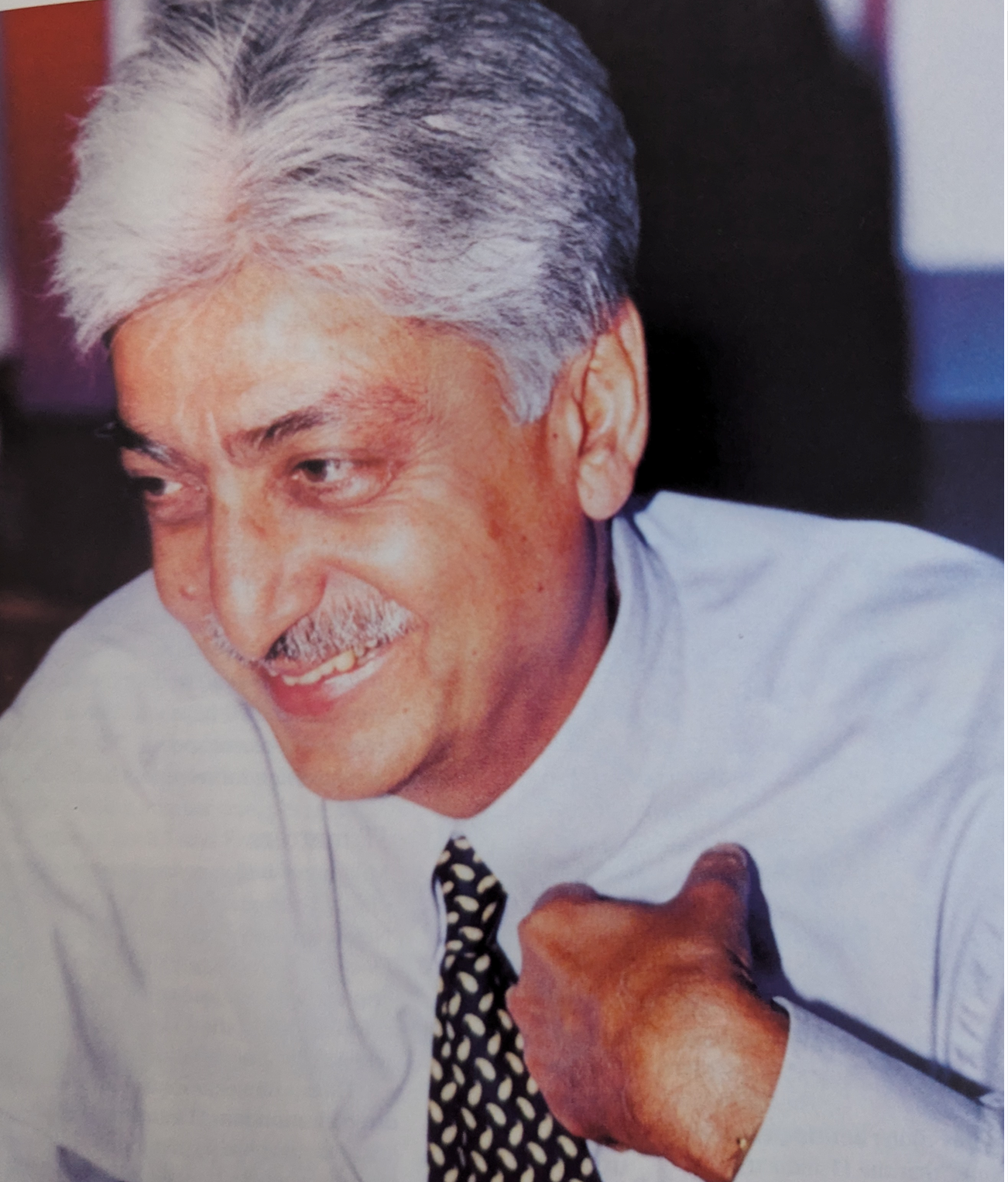
Even with a headful of flu, Premji is charm itself. Thoughtful, considered and infinitely questioning, he combines the physical presence of a Nobel prize-winning scientist with the urbanity of a senior statesman.
He gently informs me he finds speculation about his wealth embarrassing, and doesn’t want to talk about it. His only comment on lifestyle: “You can’t consume any more.”
It’s wonderfully Indian – and somehow emblematic of this country of contrasts. I’ve flown thousands of miles to meet the nation’s richest man, and his first sentence is that he’d rather talk about anything other than wealth.
I tingle with anticipation at the interview ahead.
Premji’s commitment to simple living is not PR. I learn afterwards he drives a basic car and prefers to walk the stairs to his office, rather than take the lift.
Premji DOES want to talk about his passion for technology, and specifically the way he thinks the internet can transform the lives of millions of people in India.
Premji pauses – his gaze lights up the space between us like the phosphorescent tip of a welding flame. I’ve never experienced a moment like it.
In the 1990s, it was fashionable for Western pundits to argue that the newly-invented ‘web’ would quickly become a first-world-only members club (and that the internet would irreversibly accelerate the gap between ‘first’ and ‘second’ worlds). Premji passionately argues the reverse: that developing nations will ‘leap-frog copper infrastructure’ to become global players in tech.
The pundits were wrong. Premji was right.
As we near the end of the meeting, I can’t resist bringing one question back to wealth. I ask Premji to name the three things that keep billionaires awake at night.
I’ve never met a billionaire before, and will probably never meet one again. I’m genuinely interested.
Premji pauses; looks into space. Everything in the room freezes. His gaze lights up the space between us like the phosphorescent tip of a welding flame. I’ve never experienced a moment like it.
His answer is just a few seconds long (but could be the plot synopsis for Succession).
“First, making more. Second, planning how to hand things over to the next generation, without compromising them. Third, giving what you have to charity.” He pauses. “The last two call for different skills.”
True to his vison, Premji gave two thirds of his wealth, worth $21bn in 2019, to charitable causes.
I want to cheer. It’s the billionaire’s existential worry-list, condensed into 31 words.
True to his vison, Premji gave two thirds of his wealth, worth $21bn in 2019, to charitable causes.
The interview closes. For the next few days – pondering the insights of a man who’d turned a family cooking oil business into a global tech giant – I explore Bengaluru.
I find myself wondering if I’ve met a tech visionary… or had an in audience with a guru. This is India, and so – of course – there’s no contradiction. While the western world locks itself into rigid definitions of ‘black and white’, India does grey. I felt as I’d had the privilege of spending time with a world-beating entrepreneur, but also a thinker embodying the relentless curiosity of Brahmagupta.
Who he? As any India coder will tell you, Brahmagupta was the seventh century Indian philosopher whose exploration of ‘nothingness’ defined the mathematical concept of zero. No Brahmagupta… no zero. No zero… no modern maths, no binary coding, no internet.
For me, Premji encompasses all these worlds.
In its people, in its thinking, and – of course – in food, India is happy to embrace parallel truths.
Travel anywhere else in the world, and you’ll have plans for the country.
Travel In India, and this country has plans for you.
Back to food.
In high-end hotels, smiling men in turbans serve me pretty versions of Indian dishes you could already get in 90s London. The places were shiny; the food was forgettable.
One morning, looking for breakfast, I follow a sign to a third-floor diner. There’s no lift (Premji would have approved) and the restaurant is a simple, open terrace with five or six tables and a couple of fans.
It’s early, and I am the only guest.
Would I like an Appam, asks the waiter.
I have no idea what an Appam is.
I ask what it’s served with.
“Stew” he replies.
I’m incredulous. They’re going to serve me a meat stew for breakfast?
But, as always, India knows best.
Travel anywhere else in the world, and you’ll have plans for that country.
Travel In India, and this country has plans for you. Go with the flow, and India will give you what you need.
I nod my head to ‘Appam and stew.’
My foodie world is about to explode.

At its top, the Appam is as fragile as parchment. At its base, it’s as moist as a kiss.
Fast forward.
We’re back in Bangalore.. it’s 2023.
Nupur has returned to my table.
My minutes of anxious waiting are over.
“Here is your Appam,” she says.
Seeming to float a few millimetres above a white plate, it’s the size and shape of a crown.
What is an Appam?
Let’s start with the basics. In terms of pure physics, it’s a combination of fermented rice and urad dal – blended with cooked rice, coconut milk, salt and sugar.
You can serve it with curry, or as a dessert, and eat it with any meal of the day.
If you’re feeling really brave, you can learn how to cook it here.
But reducing the appam to its physical properties is like describing the Crown Jewels as an amalgam of metal and rocks.
Let’s start with the sheer beauty of the thing.
At its lip, the appam is purest, unblemished white – like the lace at a lady’s wrist in a Vermeer painting. Just below, it morphs into something else – diaphanous and translucent – like a radiant halo in mediaeval stained-glass. You can actually see through an Appam.
Then there’s the touch.
At the top, an Appam is feather-light and fragile – almost like parchment. It crumbles when you touch it. But at its base, the Appam is two-fingers deep of spongey heaven; moist as a kiss.
Reducing the appam to its physical properties is like describing the Crown Jewels as an amalgam of metal and rocks.
And finally, the taste. An enigma of tart, savoury batter… meets sweet coconut cream.
It shouldn’t work, but your mouth instantly shouts that it absolutely, exquisitely does!
Eaten by itself, the Appam doesn’t so much melt in the mouth, as evaporate… transmogrify… sublimate… become other.
Gossamer-light, it floats in the mouth like a line of poetry. You ask yourself if it’s a dish, or an idea.
And that’s before it meets the ‘stew’.

What is ‘stew’?
It’s an enigma… the foodie equivalent of the Higgs Boson particle… a dish so rare that the easiest path is to question its existence.
In 30 years of enjoying Indian food, I’ve never seen it on a menu. Not once.
Eating in many hundreds of Indian restaurants, I’ve only been offered it only twice.
In a collection of 20 South Indian cookbooks (in a wider collection of 150 Indian recipe books), ‘stew’ is mentioned only once.
Your mouth struggles to make sense of these familiar garden vegetables… parading as tropical carnival queens.
Tucked away in the vanishingly obscure Aanavilasam Cuisine (bought in Kolkata in 2016), ‘stew’ is a foodie paradox.
In this recipe, a handful of ‘western’ vegetables (cauliflower, carrot, runner beans, green peas) meet a tsunami of exotica (curry leaves, black peppercorns, cinnamon bark, green cardamom, chillies and coconut milk).
The result? An astonishing, creamy broth – where your mouth struggles to make sense of these familiar garden vegetables parading as tropical carnival queens.
The ‘stew’s’ purpose in life? To be the eternal bridesmaid to the Appam.
It has no other known role than to float seductively in the lacey bowl of its more famous counterpart.
It does this very, very well.
If you know someone who serves ‘stew’ – anywhere in the world – please tell me.
I will go.
And taste the wild incongruity of these two idiosyncratic dishes.
And that’s the point.
Like the country of exquisite contrasts that breathed it into life – the Appam is a kaleidoscope of contradictions.
Savoury… but sweet. Thin as parchment… but thick as crème pâtissier. Solid… but see-through. Hot… and cold. Dry… and moist.
And the moment you eat it, you know the Appam is giddyingly happy in its non-binary, oxymoronic, enigmatic duality.
And wants you to be happy too.
Like the country of exquisite contrasts that breathed it into life – the Appam is a kaleidoscope of contradictions.
“Can I serve you now?” asks Nupur.
And she must, because the Appam has one other vital lesson to share.
Even as you watch it, it’s changing.
The lacey upper lip is losing its exquisite brittleness; the moist centre is cooling and drying.
In a matter of moments, it will be gone.
Somewhere in Doris Lessing’s Golden Notebook, she says the true aim of a great novel is to capture the human condition. For me that’s what an Appam does: serves me a universe of meaning on my plate.
You cannot own an Appam, or keep it. It’s as fleeting as a baby’s smile.
All you can do is enjoy it.. embrace its warm impermanence… savour its momentary, butterfly-fragility.
If I were Dr Johnson, inventor of the English dictionary, I would have slipped in the word ‘appamic’: transient, evanescent, fleeting, ephemeral.
You cannot own an Appam, or keep it. It’s as fleeting as a baby’s smile.
‘Carpe diem,’ whispers the Appam.
Live in the moment… that’s all there is.
Stop; focus; enjoy what’s in front of you; open your senses.
And here you have it – the delicious contradiction at the heart of the Appam: that the culture which has arguably done more than any other to help mankind to explore the infinite… has also given us the dish which defines the impermanent.
When were you last truly alive?
When did you last live 100 per cent in the moment… completely free to enjoy every stimulus around you?
The Appam dares you to try!
In its transient sublimity, the Appam invites you to attempt that simplest/ hardest thing… to be fully conscious of being alive.
“Eat me,” says the Appam, “and taste the present.”
When is life ever perfect?
Truly… breath-takingly… exquisitely… giddyingly perfect?
Reader, you know the answer: when you’re eating an Appam.
In its transient sublimity, the Appam invites you to attempt that simplest/ hardest thing… to be fully conscious of being alive…. to live.
Thank you, Mr Premji.
Thank you, Nupur and the Oberoi team.
Thank you, India.


 Good Korma