
Have you ever travelled an entire country… to find a single ingredient, and cook it?
We did! Join us on the adventure.

What is YOUR dream?
What’s the gift life could offer you… if all your planets aligned? And who are the ‘dream team’ who could make it happen?
I’m standing in rural Karnataka, southern India – in a village too small even to have a road sign – and I’m looking at my dream.
Or, at least, I’m looking at a tantalising sliver of it.
To almost anyone else, the thing in front of me is an unremarkable tree-cum-bush, about three metres high. Here and there, it has sprays of tiny flowers – brilliant white, like jasmine.
I’m looking at my dream… or, at least, at a tantalising sliver of it.
I want to shout with excitement.
It’s taken me seven years, and two cycle trips across India, to find – what for me – is the rarest curry ingredient in the universe…
DRUMSTICK FLOWERS!!
DRUMSTICK FLOWERS!!
Rewind
Spool back 20 years or so to the start of my ‘curry career’, and the first ever dish I cooked was a South Indian sambar… with ‘drumsticks’.
I remember discovering the bizarre new vegetable in Shepherds Bush market – and taking it home on my bike, wondering if this ridged, rigid thing was even edible. At eighteen inches long, the drumsticks poked out of my cycle pannier like mini tent poles.
Drumsticks are the pendulous seedpod of the moringa tree (named after the Tamil murungai or ‘twisted pod’). For countless Tamil and Keralan recipes, drumsticks are the magic ingredient that gives south Indian cooking its mystique… with a fragrance somewhere between spring grass and asparagus.
Above all, drumsticks are the subtle heartbeat of sambar, the dish that graces every table in south India. You can find drumsticks in most Asian food stores. I cook with them as often as I can.
Drumsticks are the magic ingredient that gives south Indian cooking its mystique… with a fragrance of spring grass and asparagus
Much, MUCH harder to find in the UK – and even in India – is the foliage of the moringa tree: drumstick leaves.
Turning the pages of the exquisite Milk, Spice & Curry Leaves many years ago, I found a recipe for fresh crab and drumstick leaves. I was intrigued. I had no idea moringa leaves were even edible. But in almost two decades of exploring the retail temples of rare Asian ingredients – from Brick Lane to Southall – I’d never seen them. Ever.
In a coincidence that I still can’t quite explain, I shopped the next day in Bhavin’s – an Indian greengrocer in Tooting I’d never visited before. To my complete astonishment, they had fresh drumstick leaves.
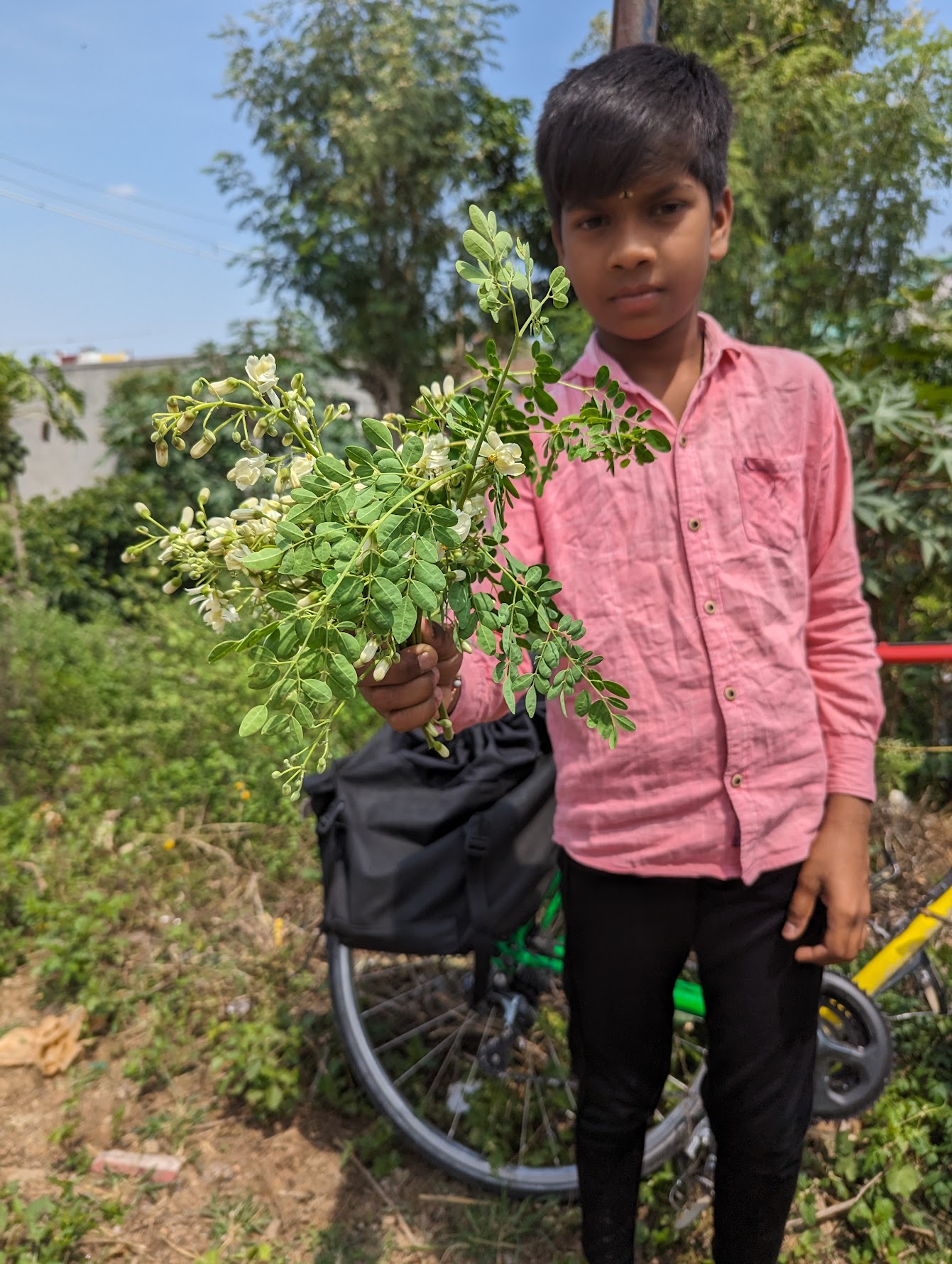
Is God a cook?
Before then, I’d never seen drumstick leaves in any other shop in the UK, or India. But on the morning I needed them, they were there.
The crab and drumstick leaf dish was insanely delicious.
So, when I chanced upon a recipe for DRUMSTICK FLOWERS, I knew this was something I HAD to cook.
Thanks to the nerdy way I use recipe books, I can date the moment this journey started.
Two words… DRUMSTICK FLOWERS… that would launch me on a seven-year quest.
Opening any new curry cookbook (I buy six to ten a year), I scribble the date on the inside cover. So, it’s thanks to Parsi Food & Customs that I know my DRUMSTICK FLOWER pilgrimage began in June 2016.
On page 141, there’s a recipe for Eggs cooked on drumstick flowers. I highlighted the new ingredient with two exclamation marks.
Two words… DRUMSTICK FLOWERS… that would launch me on a seven-year quest.
Rarer than hen’s teeth
Maybe you’ve never seen or heard of DRUMSTICK FLOWERS.
You’re not alone.
Even in their native country of India – where moringa trees grow wild – DRUMSTICK FLOWERS are not sold anywhere I’ve ever been.
I’ve looked for them across the breadth of India, and asked for them in countless markets from Kochi on the west coast to Pondicherry on the east.
In fact, I cycled that entire distance in 2019 – 800km, coast to coast – and didn’t see a single flowering moringa tree.
Even in their native country of India – where moringa trees grow wild – DRUMSTICK FLOWERS are not sold anywhere I’ve ever been
Conscious we hadn’t found what we were looking for, the team I was travelling with kindly bought me dried, ayurvedic drumstick flowers. Not the same thing.
With each passing year, the DRUMSTICK FLOWER became my Holy Grail… the dish I couldn’t rest until I’d cooked.
My curry dream.
The longer the hunt went on, the more irresistible the dish becomes in my head.
Back to the future
Fastforward.
It is October 2024, and I am back in India.
It is Day One of a cycle ride from Mysore to Calicut – organised by the superlative Kalypso Adventures.
After breakfast, I explain to my guides Jeffin and Das that this trip is about one thing… DRUMSTICK FLOWERS.

I had brought recipe books with me from home, filled my phone with links to recipes. I had the hunger… what I didn’t have was the raw ingredient.
Somehow, we were going to find it… and together we’d cook and eat the rarest curry recipe known to man.
Was this the weirdest brief these two experienced tour guides have been given? If so, they didn’t let on.
We set off.
Drumroll
On day three – 200km into our cycle odyssey across rural India – Jeffin suddenly pulls to the side of the road.
Jeffin is my polyglot, multiskilled cycle guide. He speaks fluent Malayalam, Hindi, Kannada, English… and probably other languages too. He has the eyes of an eagle – and can spot life forms at any distance. In one of his parallel careers, he’s a farmer – and can identify any species of plant we see in a fortnight’s cycling together.
He’s going to use all these skills in getting us our first bunch of DRUMSTICK FLOWERS.
Because it is happening… right next to us on the road… a flowering moringa tree!!
After one and a half trips across India – and almost 1,000km cycled – I’m looking at my dream.
There’s enough blossom on the tree to cook an entire meal. The search is over! I assume we’re going to harvest every flower.
Wrong.
Jeffin patiently explains this is someone’s drumstick tree, and that they will almost certainly want the vegetables that follow the flowers.
After one and a half trips across India – and almost 1,000km cycled – I’m looking at my dream
Which is why, of course, you never see DRUMSTICK FLOWERS for sale. Why pluck a flower – weighing a fraction of gramme, with a shelf-life of three days – when it’ll grow into a vegetable weighing 100g, that lasts for weeks?
Jeffin is right. As we talk, a mother and her children appear. This is their tree.
Speaking in Kannada, Jeffin patiently explains to them that this foreign cyclist wants to cook a curry with DRUMSTICK FLOWERS.
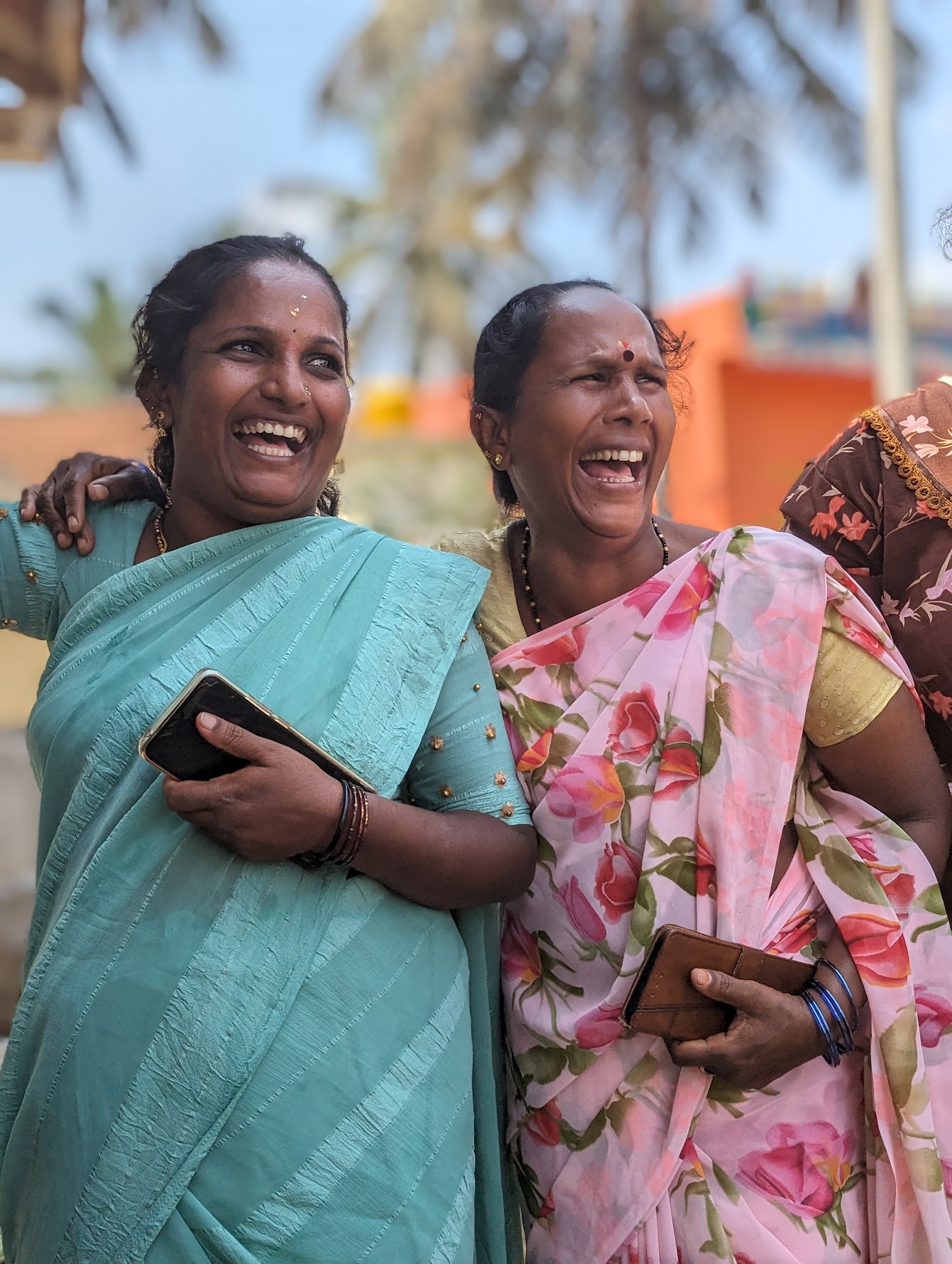
Eyebrows raise. Then people start to smile.
Of course we can take some.
The woman and her children help us to bring down some of the lower branches, and we pick a small bagful. They will not take any payment.
Anywhere I’ve ever travelled, one law holds true: the less people seem to own, the happier they are to share it.
Mounting tension
We have, I reckon, about ten per cent of what we need to cook a DRUMSTICK FLOWER curry.
Is this dish going to happen?
Halfway through the next day, another 60km down the road, Das spots our second moringa tree.
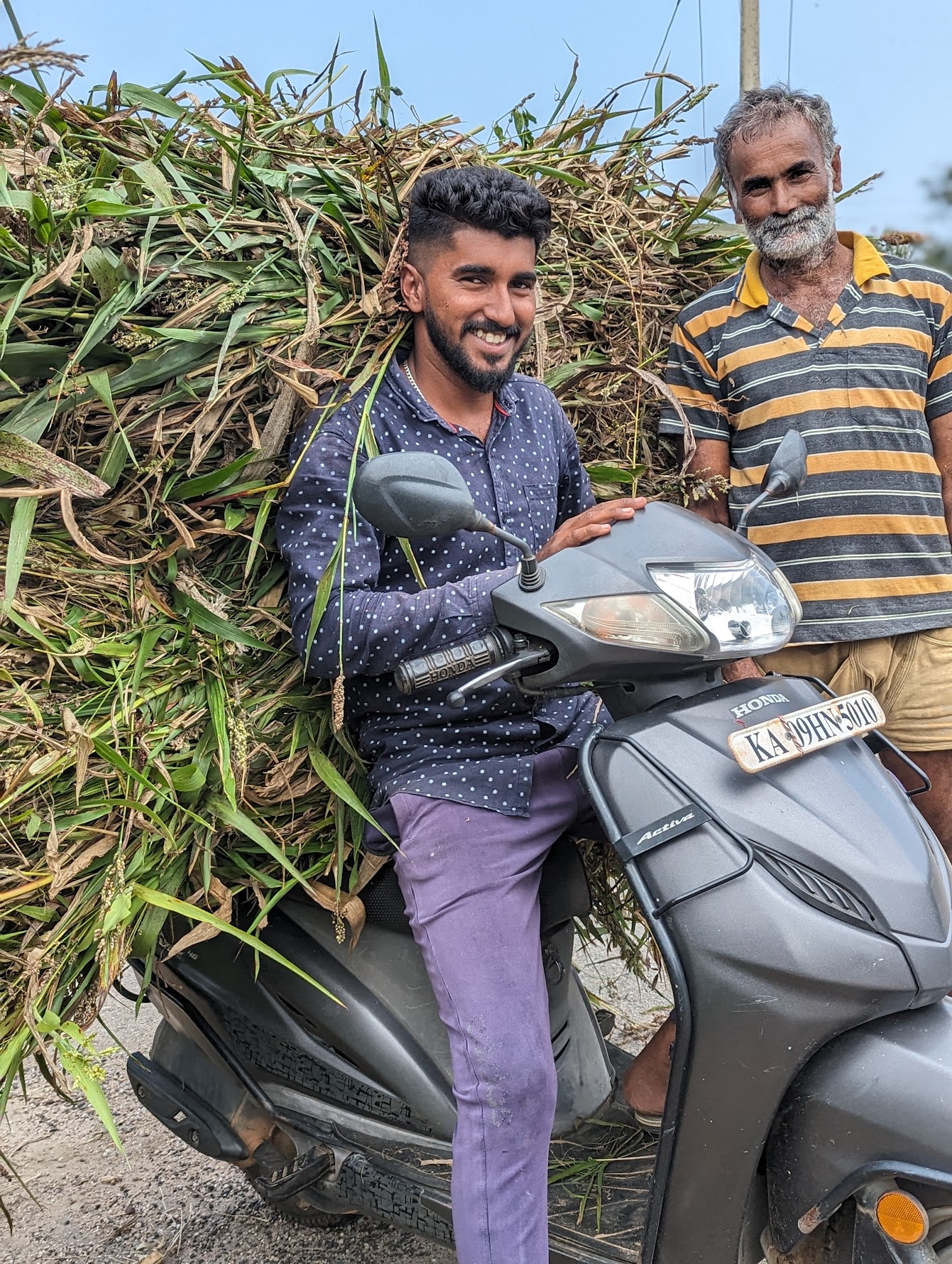
It belongs to two farmers – father and son – who are working next to it as they gather feed for their cattle.
Das is our driver: patiently trailing Jeffin and me in a van on any busy sections of road, he will pop up magically whenever we need water and snacks, before driving ahead to get provisions or to find a room the night.
Minute by minute, Das has got my back.
Later in the trip, as we cycle through the Wayanad National Park – a road cutting through virgin jungle – I will stop to take a photo of a plunging waterfall. Within seconds of pulling up, I’m surrounded by five or six monkeys. Moments later, the slope above me is literally bleeding monkeys. There are now 30 or more animals, some less than five feet away. Hissing and showing their teeth.
I hear a quiet voice behind me: “Go. Adam. Go.”
It’s Das. He’s pulled up noiselessly behind me, and wound down his window far enough to talk. He knows I need to pedal out this instant.
Das has my back.
Right now, he is negotiating with the farmers. They aren’t planning to harvest the tree, and are happy for us to take as many DRUMSTICK FLOWERS as we want. Again, they won’t take payment.
We are halfway there.
Third time lucky
Around noon on the following day, under a blistering sun, Jeffin spots the third and final flowering moringa we’ll see on our 700km trip.
As always, we only have to stand looking at it for the owner to appear.
Jeffing talks with him. He’s happy for us to take the higher flowers that he won’t harvest.
One problem. They’re 20 feet up.
The branches of the moringa are brittle as an elder bush; the thing is unclimbable.
Magically, Das appears with a scythe blade, mounted on a 10-foot pole. Where did he find it?
The owner smiles as we pick what we need, and wishes us a good day.
Is there a more generous place on Earth than rural India?
It takes a village
I can hardly believe it. We have a full portion of DRUMSTICK FLOWERS!
Their fragrance fills Das’ car.
Now we have to cook them.
Over the last couple of days, Das has been hunting down each of the ingredients for the Sahjan ke phool ki Sabji… the online DRUMSTICK FLOWER recipe I’ve plumped for… with chillies, turmeric, garlic and fresh coconut.
I explain to Jeffin and Das that the coconut needs to be very finely grated. This is a problem… we have no grater.
We stop in the next village, and Jeffin asks in a couple of houses if they can help grate our coconut. They are only too happy to my help.

To my delight, in the second family home we talk to, they bring out a traditional, wood-mounted coconut scraper… a Nariyal khuruchni
I’ve tried to buy one of these in markets across India – and online – and failed. It’s the most beautiful I’ve ever seen.
With the village billy-goat gently butting the backs of my legs, to remind he’s there, I watch Jeffin grind the coconut – and listen to him translate questions from the rapidly-growing crowd.
Within minutes, there’s a relaxed group of ten or fifteen family and friends. Some live in the village, others are on visits back from jobs in the city. Each of them has the very Indian gift of making you feel welcome – exactly as you are.
Morethentic
We have everything we need.
We have DRUMSTICK FLOWERS, we have the other ingredients… we have every member of the cast to raise the curtain on a perfect Sahjan ke phool ki Sabji.
Jeffin and Das pick the spot for us to cook.
And frankly, things get a bit bonkers.

They have decided we’re going to cook in the shade of a centuries old banyan tree, with a backdrop of emerald-green basmati paddy fields. If you gave professional location-finders a month to find the perfect backdrop to foodie travel show, they wouldn’t find anything to touch it.
And then things get more bonkers still.
As we get ready to cook, Das starts to unpack his van… and an entire kitchen emerges. Gas rings, frying pans, chopping boards, colander, knives, cutlery, plates, glasses.
Suddenly, we’re in a bizarre episode of Grand Designs: ‘The Banyan Kitchen’.
I am stunned. “Is this a movie?” I ask.
“It is,” deadpans Jeffin, “and here’s your Director’s chair.” Right on cue, he opens a classic, folding Hollywood seat.
We start to cook.
With the slightly weird, synthy soundtrack of Sahjan ke phool ki Sabji playing on YouTube, Das and I separate the pearlescent DRUMSTICK FLOWERS from the leaves and stalks. We have enough blossoms to fill a colander.
One eye on the video, we step through the recipe.

Even on the emptiest road in India, you’re never alone for long. In the 40 minutes it takes to make the curry, five or six groups pass us – stopping to ask what we’re cooking under their banyan. My favourite passer-by was the gentleman herding his cattle slowly down the road. Gently twisting his sun umbrella as he talked with us, he was the perfect ‘extra’ to our eccentric, desi road-movie.
We ate.
Seven years is a long time to build up an appetite.
KA-BOOM!
In a sambar, the drumstick plays a subtle melody within an orchestra of 15 to 20 ingredients.
In Sahjan ke phool ki Sabji, DRUMSTICK FLOWERS are the star of the show. With all their blossomy perfection, the flowers kiss you with aromas of springtime and asparagus.
You’re eating curried petals, floating on fresh coconut and curry leaves.

It is giddying.
People who know MUCH more than me about curry… people who’ve cooked as chefs over glittering careers, published books, starred on TV… are adamant that ‘authentic’ doesn’t exist. That there’s no such thing as an ‘authentic curry’.
That is their truth.
You’re eating curried petals, floating on fresh coconut and curry leaves.
But sitting in the shade of a banyan tree, with my friends Jeffin and Das, eating Sahjan ke phool ki Sabji… made from flowers we plucked fresh from the tree, flavoured with coconut grated on a Nariyal khuruchni.. this dish isn’t just authentic. It’s morethentic!
I am in foodie heaven.
Dew respect
As a currency, are dreams worth more saved or spent… unlived or lived?
I’m open to views.
All I know is that, for me, DRUMSTICK FLOWERS are the invitation to a party that rolled hundreds of kilometres across India, connecting me with the kindness of so many people on the way.
Above all, DRUMSTICK FLOWERS are the foodie pilgrimage that introduced me to my Dream Team, Jeffin and Das… and the chance to watch two people turn a fortnight’s journey into an unforgteable experience…

… swimming with pilgrims in a sacred river, hiking to a prehistoric cave, watching incense rise from an offering in a temple in the heart of the forest.
Jeffin and Das made it all happen.
Thank you, Dream Team.
And thank you Thomas at Kalypso Adventures, who orchestrated everything.
Where next?
The Lucknow Cookbook (opened September 2022) hooked me with a paragraph on Nimish – a dessert unique to this city of northern India: “The basic preparation of Mimish is when milk is poured into large flat plans and left in the open before dawn. When the early morning dew falls on the milk, it creates froth as light as air.”
Cooking with dew!! Who’s in?
I need my Dream Team to take me to Lucknow.
Postscript
One month after the trip, Das and I share regular WhatsApp messages.
Even in London, he still has my back.
If monkeys surround me any time in my urban jungle, Das will have me covered.
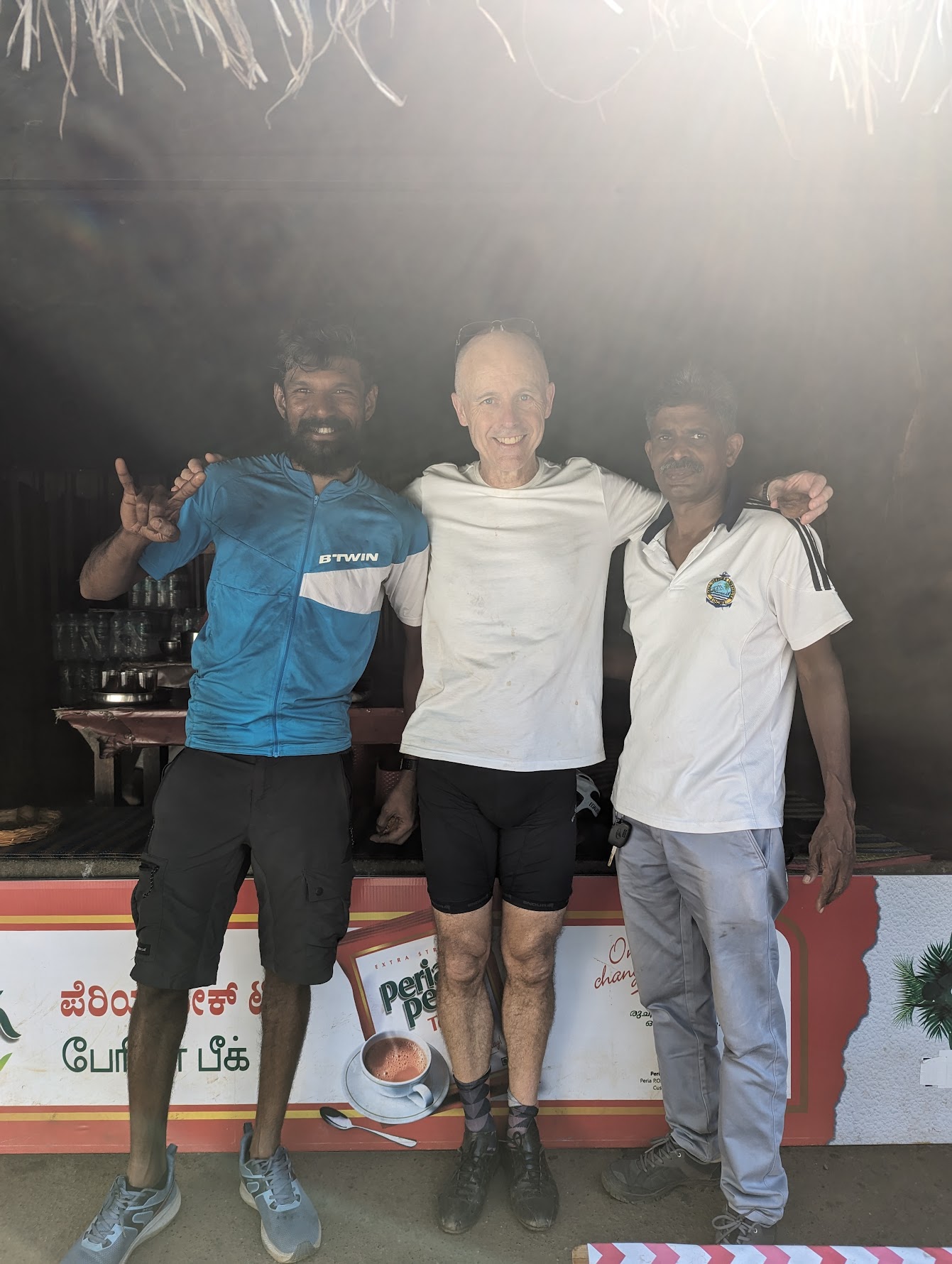


 Good Korma